Best Platforms for Selling Digital Downloads in 2026
Compare top platforms for selling digital downloads in 2026 — fees, pricing, tax handling, and which option fits your stage.
Best Platforms for Selling Digital Downloads in 2026
Selling digital downloads in 2026? Here's what you need to know:
- Gumroad: Easy to start, 10% fee per sale (30% if sold via their marketplace). Ideal for beginners but costly for high sales volume.
- Shopify: Starts at $39/month. Great for scaling, but requires additional apps for digital products and manual tax management.
- Etsy: Charges ~12-15% total fees. Offers built-in traffic but limits branding and access to customer data.
- Podia: All-in-one platform with plans from $39/month. Good for courses and memberships but lacks advanced customization.
- Teachable: Best for structured courses. Starter plan is $39/month with a 7.5% fee, but higher tiers remove transaction fees.
- Payhip: Free plan with 5% fee or $29/month for 2% fee. Straightforward and scalable for digital products.
- Sellfy: Flat pricing from $22/month. No platform fees, supports large files, and includes print-on-demand options.
- SamCart: Starts at $79/month. Focused on checkout optimization with upselling tools but lacks a built-in marketplace.
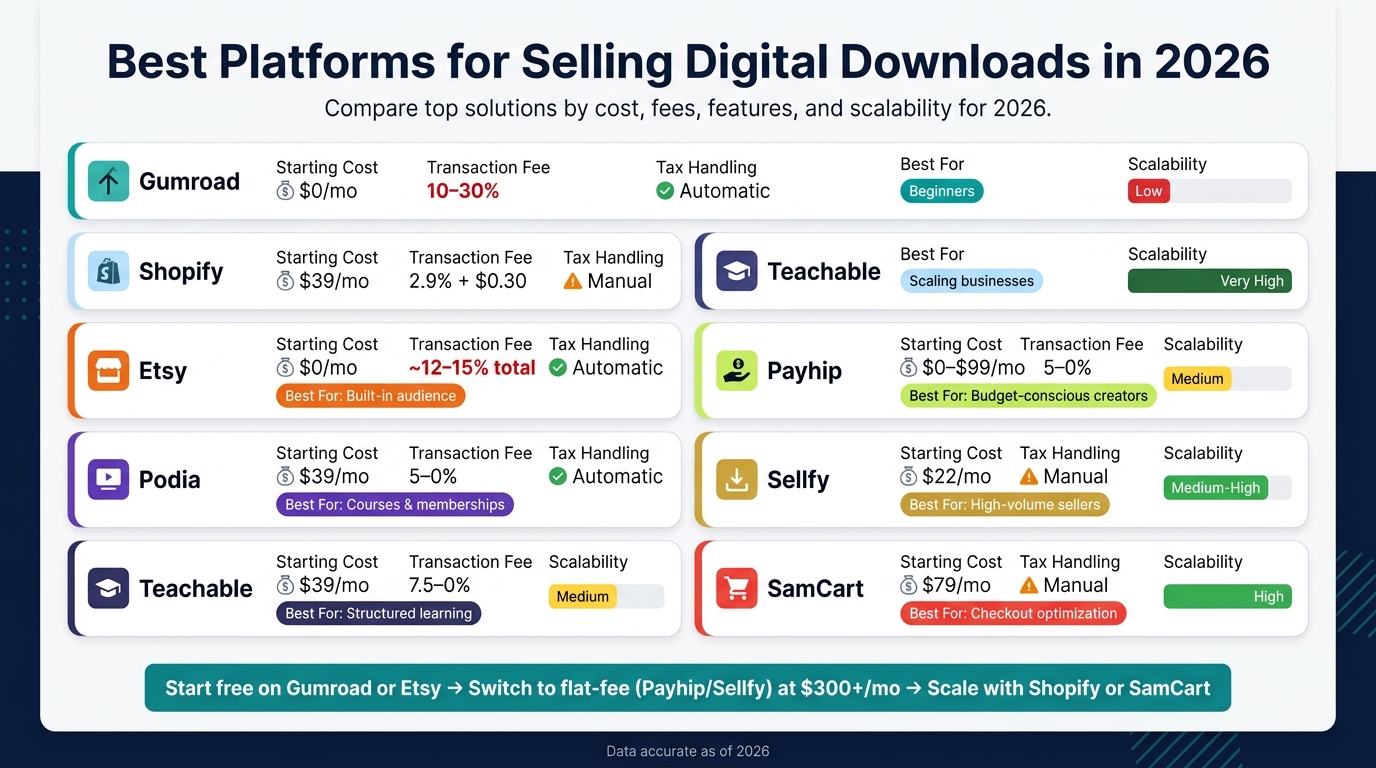
Quick Comparison:
| Platform | Starting Cost | Transaction Fee | Tax Handling | Best For |
|---|---|---|---|---|
| Gumroad | $0 | 10–30% | Automatic | Beginners |
| Shopify | $39/month | 2.9% + $0.30 | Manual | Scaling businesses |
| Etsy | $0 | ~12–15% | Automatic | Built-in audience access |
| Podia | $39/month | 5–0% | Automatic | Courses & memberships |
| Teachable | $39/month | 7.5–0% | Automatic | Structured learning |
| Payhip | $0–$99/month | 5–0% | Automatic | Budget-conscious creators |
| Sellfy | $22/month | 0% | Manual | High-volume sellers |
| SamCart | $79/month | 0% | Manual | Checkout optimization |
Each platform has trade-offs between fees, scalability, and control. Start with low-cost options like Gumroad or Etsy to test your products, then switch to platforms like Shopify or Payhip as your business grows. Focus on balancing fees with audience access and scalability to maximize profits.
Best Platforms for Selling Digital Downloads in 2026: Side-by-Side Comparison
best platforms to sell digital products online in 2026
sbb-itb-e9b8513
1. Gumroad
Gumroad is a straightforward platform for selling digital downloads. It doesn't charge a monthly fee but instead takes a flat 10% cut from each direct sale, along with standard payment processing fees (approximately 2.9% + $0.30 per transaction through Stripe or PayPal). This adds up to an effective rate of about 13.2% for U.S. transactions. However, if a buyer discovers your product through Gumroad's internal "Discover" marketplace instead of your direct link, the fee jumps to 30%. This makes it crucial to drive traffic to your products yourself.
The platform supports a variety of digital products, such as e-books, software with license key generation, online courses, music, design templates for tools like Notion and Canva, digital art, photography, and even memberships. Plus, getting started is quick - it takes less than 15 minutes to set up.
Gumroad also offers a built-in affiliate program to help boost sales. For instance, a Python course creator named Sarah launched her $299 course on Gumroad in 2025. Within six months, she earned $42,000 in revenue, with 35% of the sales coming from affiliates. This kind of automated affiliate support is hard to replicate manually.
While Gumroad's 10% fee structure is ideal for beginners, it can become costly as sales grow. For example, earning $5,000 per month means paying $500 in fees. According to InsightRaider Research:
"The crossover point where Shopify becomes cheaper than Gumroad sits around $480 per month in digital revenue."
One advantage of Gumroad is that it acts as a Merchant of Record, automatically managing global sales tax and EU VAT as of January 1, 2025. This simplifies international sales for creators. However, the platform does have its limitations. Its analytics are basic, storefront customization options are limited, and there's no advanced course builder - features that creators may find restrictive as they scale. These drawbacks often lead users to explore other platforms as their needs evolve.
2. Shopify With Digital Delivery Apps

Shopify isn't specifically designed for digital downloads right out of the box, but with the right apps, it becomes a highly adaptable platform for selling digital products. The Basic Shopify plan starts at $39/month (or $29/month when billed annually) and includes standard processing fees of 2.9% + $0.30 per transaction. Shopify also offers a free Digital Downloads app, which supports files up to 5GB. For those needing advanced features, apps like SendOwl and Sky Pilot provide added tools like PDF stamping, download limits, expiring links, and even streaming capabilities, with pricing ranging from $9 to $39 per month. However, if you choose not to use Shopify Payments, an additional 2% fee is applied on top of your processor's charges.
One of Shopify's standout features is its scalability, allowing creators to grow their businesses as they expand their digital product offerings. For example, even with $5,000 in monthly revenue, platform costs remain relatively low, ensuring you keep a significant portion of your earnings. Marcus, an ecommerce development expert, highlights Shopify's strengths:
"Shopify is the best ecommerce platform for digital products for most businesses. It pairs a high-converting checkout, robust app ecosystem for digital delivery and licensing, and first-class accounting integrations."
Shopify supports a wide variety of digital products, including ebooks, templates for Notion and Canva, software license keys, video courses, music, and even AI prompt packs - a category projected to grow rapidly by 2026. It also accommodates hybrid stores, making it possible to sell both physical and digital products from the same platform.
That said, Shopify does have a notable drawback: it's not a Merchant of Record. This means that it doesn't automatically handle VAT, GST, or U.S. sales tax collection and remittance. Sellers need to manage tax compliance manually or use a separate tax app, which can add to both costs and complexity, especially for international businesses.
Shopify's ability to scale and adapt makes it a strong choice for creators, laying the groundwork for comparisons with other platforms.
3. Etsy for Digital Downloads
Etsy uses a layered fee system that sellers need to consider. Each listing costs $0.20 (renewable every four months or after a sale), and there’s a 6.5% transaction fee on the sale price. Additionally, payment processing fees are 3% plus $0.25 per transaction. Altogether, this creates an effective fee range of about 10% to 16%, depending on your pricing. For shops earning over $10,000 annually, Offsite Ads add another 12%–15% on referred sales. For instance, a seller making $10,000 in revenue during a month might only net around $7,625 after fees.
Despite the fees, Etsy’s massive audience provides a huge advantage for creators. With over 95 million active buyers and more than 5 million digital product listings as of 2026, even new sellers can make sales without investing in ads. Maria, who runs a Printable Planner Shop, shares her experience:
"The built-in traffic means I make sales while I sleep. I've earned $3,200/month consistently with zero paid ads. Competition is fierce, but good SEO wins."
Etsy works especially well for visually appealing digital products like printables, planners, SVG files, Canva templates, wedding invitations, and wall art. AI-generated designs are also becoming more popular on the platform.
However, there are limits to consider. Etsy restricts file uploads to 20MB and allows only five files per listing. Sellers with larger files often include a PDF containing a secure external download link. On the plus side, Etsy simplifies tax compliance by acting as a Marketplace Facilitator, automatically managing VAT and U.S. sales tax collection and remittance.
Scalability can be tricky. As eCommerce expert Curtis Blackmore points out:
"Etsy gives you built-in traffic and a low barrier to entry - but at 6.5% per sale plus listing fees, margins shrink significantly as sales grow."
Another limitation is Etsy’s lack of access to customer email addresses, which makes building an independent mailing list challenging. To work around this, many sellers include a lead magnet link in their digital downloads to encourage email sign-ups. For many creators, Etsy serves as a starting point to validate their products and build initial cash flow. Once monthly revenue reaches $1,000–$2,000, sellers often transition repeat customers to a self-hosted store for better control and profitability.
4. Podia

Podia is a versatile platform tailored for creators looking to sell digital products. It’s an all-in-one solution that combines your website, digital storefront, email marketing, and community tools under one subscription. By consolidating these services, Podia can save users anywhere from $29 to $299 per month on third-party tools. The platform supports a variety of product types, including online courses, e-books, PDFs, templates, coaching sessions, webinars, and even software license keys - all with no file size limits.
Pricing and Plans
Podia’s pricing is simple and transparent. The Free plan includes an 8%–10% transaction fee, while the Mover plan ($39/month) drops the fee to 5%. The Shaker plan ($89/month) eliminates transaction fees entirely and adds affiliate marketing tools. For creators earning over $840 per month, upgrading to the Shaker plan makes financial sense, as it removes the 5% fee on every sale.
| Plan | Monthly Price | Transaction Fee | Notable Features |
|---|---|---|---|
| Free | $0 | 8%–10% | 1 download, 1 coaching product, full website |
| Mover | $39 | 5% | 50 products, courses, email marketing |
| Shaker | $89 | 0% | Affiliate marketing, PayPal support, 150 products |
| Earthquaker | $199 | 0% | Unlimited products/videos, priority support, free migrations |
Key Features
Podia includes practical tools like an AI-powered course outline generator, which helps creators structure their courses more efficiently. While it’s not a full-fledged AI suite, it’s a handy feature for saving time. Additionally, the platform simplifies international sales by automating sales tax and VAT compliance for 230 countries, reducing a major administrative burden for global creators.
Limitations and Trade-Offs
Podia prioritizes simplicity, which means it may lack some advanced features found on other platforms. For example, its course builder doesn’t include advanced quizzes, graded assignments, or mastery-based certificates. Similarly, its website builder offers limited design flexibility compared to more customizable platforms.
However, for creators who sell a mix of products - such as downloads, webinars, and memberships - and don’t require enterprise-level tools, Podia offers a streamlined way to grow from a side hustle to a full-time business. It eliminates the need for juggling multiple tools, making it a practical choice for many.
5. Teachable

Teachable is a major player in the online course space, facilitating over $1 billion in creator earnings each year for more than 150,000 businesses. As of 2026, it offers four pricing tiers - Starter, Builder, Growth, and Advanced - designed to scale with creators' needs.
Pricing and Transaction Fees
Teachable's pricing structure is tailored to reward creators as their revenue grows. The Starter plan, priced at $39 per month, includes a 7.5% transaction fee. For example, if you generate $5,000 in monthly revenue on this plan, you’ll pay $375 in transaction fees, adding up to about $4,500 annually. Once your monthly revenue surpasses $1,000, upgrading to the Builder plan at $89 per month (with 0% transaction fees) becomes a more economical choice.
| Plan | Monthly Price | Annual Price (per mo) | Transaction Fee |
|---|---|---|---|
| Starter | $39 | $29 | 7.5% |
| Builder | $89 | $69 | 0% |
| Growth | $189 | $139 | 0% |
| Advanced | $399 | Custom | 0% |
Note: Standard payment processing fees (2.9% + $0.30 for U.S. cards) apply to all plans.
In addition to its pricing, Teachable incorporates AI to enhance both course creation and the student experience.
AI Tools and Digital Product Support
Teachable is built for structured courses but also supports digital downloads. Its AI toolkit, Create with AI, simplifies course creation by generating outlines, quizzes, and lesson summaries automatically. An AI-powered student support agent is another standout feature, offering answers to learner questions based on the course content. While its primary strength lies in structured learning, Teachable’s support for digital downloads makes it versatile enough for creators offering various types of content.
Trevor Fenner, Owner of Ecommerce Paradise, highlights its strengths:
"Teachable wins for structured course businesses where students complete a learning journey."
Scaling on Teachable
For creators aiming to scale, Teachable’s Builder plan and higher tiers include tools like built-in affiliate systems, progress tracking, and mobile access for students. Offering payment options such as Afterpay and Klarna can increase conversion rates by 20–40%. Additional features like completion certificates and drip-feed scheduling enhance the learning experience, particularly for premium courses.
Teachable shines for structured courses priced between $97 and $2,000+, where its advanced tools and depth of features justify the cost. However, if your focus is solely on selling simple digital products without a learning component, a more streamlined platform might better suit your needs. These features underscore Teachable’s emphasis on delivering a complete course experience, setting it apart as we explore other platforms.
6. Payhip
Payhip stands out with its flexible fee structure, catering to creators at all levels. Its Free Forever plan has no monthly charges, taking only a 5% transaction fee per sale. This makes it an appealing option for creators just starting out.
| Plan | Monthly Fee | Transaction Fee | Best For |
|---|---|---|---|
| Free Forever | $0 | 5% | New creators testing products |
| Plus | $29 | 2% | Sellers with steady monthly sales |
| Pro | $99 | 0% | High-volume sellers ($3,000+/month) |
Note: Standard payment processing fees (around 2.9% + $0.30 via Stripe) still apply to all plans.
The upgrade math is straightforward. For example, if your sales surpass $967 in a month, the Plus plan’s lower transaction fee offsets its $29 monthly cost. At $5,000 in monthly revenue, moving to the Pro plan saves you $401 compared to sticking with the free tier.
Unlike some platforms that handle payments as the merchant of record, Payhip connects directly to your Stripe or PayPal account. This means faster payouts and more control over your earnings.
Payhip supports a variety of product types, including:
- Ebooks
- Online courses with drip content
- Memberships
- Coaching sessions
- Software (with automatic license key generation)
- Physical goods
For ebook sellers, Payhip offers a PDF stamping feature that watermarks files with the buyer’s name and email, helping track unauthorized sharing. It also simplifies tax compliance by automatically calculating and remitting EU and UK VAT - saving you time when selling to European customers.
On the marketing front, Payhip offers tools like an affiliate program and Social Discounts, which encourage customers to share your products on social media in exchange for coupons.
"If you're budget-conscious and want room to grow without being penalized for your own success, Payhip's tiered pricing is genuinely smart design." – CuraPicks
However, there are some trade-offs. Payhip’s storefront, while functional, lacks advanced design customization, which could be a drawback if branding is a top priority. Additionally, its analytics and SEO tools are relatively basic, which might limit creators earning over $30,000 per month.
7. Sellfy
Sellfy uses a straightforward subscription model with no platform transaction fees. Creators pay a flat monthly subscription fee and standard processing fees (usually about 2.9% + $0.30 through Stripe or PayPal). This setup is ideal for creators aiming to grow their business without unpredictable costs.
| Plan | Monthly (Billed Monthly) | Monthly (Billed Annually) | Annual Sales Limit |
|---|---|---|---|
| Starter | $29 | $22 | Up to $10,000 |
| Business | $79 | $59 | Up to $50,000 |
| Premium | $159 | $119 | Up to $200,000 |
Creators earning over $200,000 annually can contact Sellfy for custom pricing.
The pricing structure becomes more appealing as sales grow. For instance, the flat fee pays off when monthly revenue reaches around $220, making it more economical than percentage-based fees. At $5,000 in monthly revenue, creators could save approximately $471 compared to platforms that charge a percentage of sales. For example, upgrading to the Business plan can significantly reduce fees and increase monthly profits.
"Sellfy is the most cost-effective option for sellers generating between $500 and $3,000 per month, a range where flat monthly fees consistently outperform percentage-based models." – Alpha Market
Sellfy supports a variety of digital products, including ebooks, video tutorials with built-in streaming, music, software, fonts, PSD templates, and Procreate brushes. Each product file can be as large as 20GB, and sellers can include up to 50 files per product.
The platform also integrates print-on-demand services through 11 global fulfillment centers, so you can sell physical merchandise alongside digital products without needing third-party apps. To help boost revenue, Sellfy offers built-in tools like upselling pop-ups, abandoned cart recovery, and affiliate marketing on the Business and Premium plans. However, if you exceed the annual sales cap, a 2% overage fee applies until you upgrade.
8. SamCart
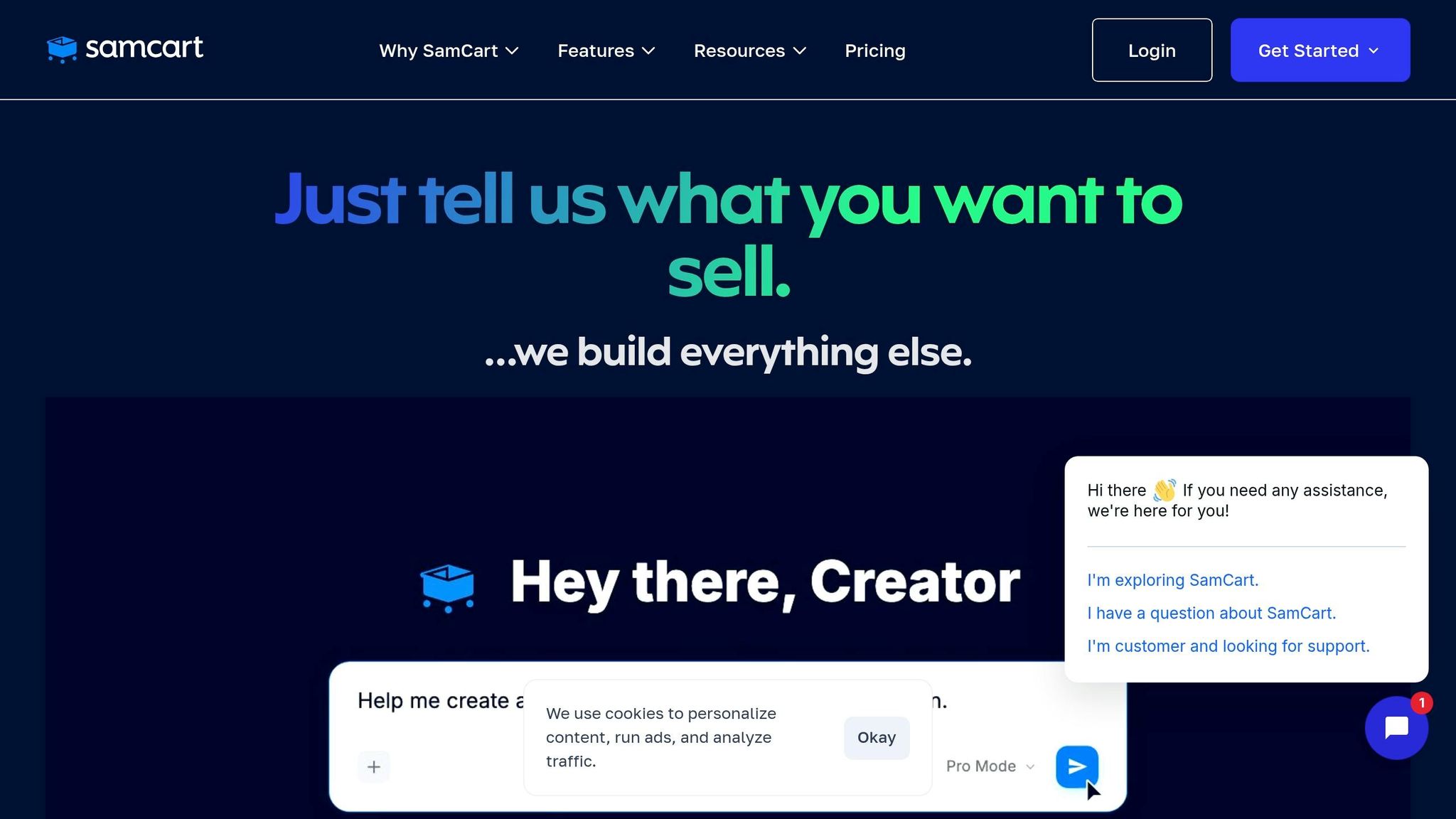
SamCart takes a checkout-first approach, positioning itself as a platform designed to maximize revenue. With over $7 billion in transactions processed across 75,000+ businesses, it’s built for creators and businesses looking to optimize their sales process.
One standout feature? No platform transaction fees. You’ll only pay the standard processing fees: 2.9% + $0.30 per transaction through SamPay or Stripe, along with variable tax fees depending on your plan.
| Plan | Monthly Price | Billed Annually | Key Features |
|---|---|---|---|
| Core | $79/mo | $59/mo | Unlimited products, AI tools, Courses App, Cart Abandonment |
| Pro | $199/mo | $149/mo | 1-Click Upsells, Order Bumps, A/B Testing, Affiliate Center, Subscription Saver |
| Enterprise | Custom | Custom | Dedicated account manager, multiple marketplaces, best processing rates |
How SamCart Uses AI to Increase Conversions
SamCart’s AI tools are designed to help businesses create and sell more effectively. The platform’s AI assistant, Sam, can generate sales copy, design landing pages in under a minute, and even suggest digital product ideas by analyzing billions of dollars in historical sales data. Meanwhile, the AI Marketing Designer, Remix, turns your product into ready-to-use content for social media, ads, and webinars almost instantly.
Another key feature is "Checkout Anywhere", which allows you to embed checkout options as pop-ups or slide-outs on external sites like WordPress, Squarespace, or even social media bio links. This flexibility is perfect for creators selling digital products like eBooks, online courses, memberships, and coaching programs.
Revenue-Boosting Tools
For creators looking to scale, SamCart’s upselling tools can make a huge difference. Adding just one 1-click upsell can increase your average order value (AOV) by 68%. Combine upsells with order bumps, and you could see up to a 98% boost in AOV.
"Switching to SamCart was one of the best decisions I've made. The order bump, upsell, and split testing features have allowed us to methodically increase our AOV to double what it was before."
Things to Consider
While SamCart offers powerful tools, its pricing may not suit everyone. The starting price of $79/month can be a hurdle for smaller creators, and features like upsells, order bumps, and A/B testing are only available on the Pro plan, which costs $199/month. Additionally, there’s no built-in marketplace, so you’ll need to handle traffic generation yourself.
Pros and Cons of Each Platform
Every platform mentioned in this article has its advantages and drawbacks. To make things easier, the table below highlights the key strengths and limitations of each option.
| Platform | Pricing & Fees | AI Monetization Tools | Supported Product Types | Scalability |
|---|---|---|---|---|
| Gumroad | $0/mo, 10% per sale | Discover marketplace exposure | Large files (up to 16GB), e-books, software | Low - fees become costly at high volume |
| Shopify | $39+/mo, 2.9% + $0.30 | 6,000+ app ecosystem, no native AI | All digital + physical hybrid catalogs | Very high - ideal for growing brands |
| Etsy | $0/mo, ~12–15% total fees | AI-driven search, SEO tools | Templates, printables, e-books | Low - limited brand control |
| Podia | $39/mo (5% fee) or $89/mo (0%) | Basic automation | Courses, memberships, downloads | Medium - all-in-one but not enterprise-ready |
| Teachable | Varies by plan | Course-specific tools | Online courses, coaching | Medium - strong for education creators |
| Payhip | $0–$99/mo, 0–5% fee | PDF stamping, social discounts | E-books, courses, memberships | Medium - scales well with plan upgrades |
| Sellfy | $22–$119/mo, 0% | Built-in print-on-demand | Downloads, subscriptions, POD | Medium-high - great for volume sellers |
The key takeaway here lies in the trade-off between fees and traffic. Platforms like Etsy provide access to an existing audience but charge higher fees, which can eat into your profits. On the other hand, platforms such as Shopify require you to drive your own traffic, which comes with its own costs but offers lower transaction fees and greater control.
For beginners, starting with Gumroad's free plan or leveraging Etsy's built-in audience can be a smart way to test the waters. Once your revenue grows - say, beyond $300 per month - switching to a flat-fee model like Payhip's $29/month plan or Sellfy's Starter tier can help you keep more of your earnings. If your goal is to scale significantly, Shopify's extensive app ecosystem can provide the tools you need to grow.
This comparison underscores the importance of finding the right balance between fee structures and traffic generation as your business evolves. By understanding how fees and audience access impact profitability, you can make an informed choice that aligns with your goals.
Conclusion
There’s no one-size-fits-all platform. The best choice depends on your stage as a creator and what you’re selling.
If you’re just starting out, Etsy is a great option thanks to its massive built-in audience of 95 million active buyers. But as your monthly revenue grows beyond $300, switching to a flat-fee platform like Payhip or Sellfy can save you money. As Matt K from PromptlessPress explains:
"The mistake at every stage is jumping ahead one stage too early. New sellers who skip Etsy and go straight to Shopify spend $29/month and get zero sales because they didn't have a traffic source."
Why the $300 mark? At that point, percentage-based fees start cutting into your profit margins, making flat-fee subscriptions the smarter choice.
Every platform balances four key factors: pricing, audience access, scalability, and functionality. The right mix of these shifts as your business grows. For example:
- Course creators might find platforms like Podia or Teachable ideal for their all-in-one capabilities.
- If you’re selling software or SaaS, look for platforms that handle global tax compliance automatically to avoid legal headaches as you expand internationally.
- For creators driving traffic from social media, a mobile-first checkout is critical to turning clicks into sales.
Don’t fall into the trap of searching for the "perfect" platform. The best platform is the one you start using today.
FAQs
When should I switch from percentage fees to a monthly plan?
When your sales volume increases, switching to a monthly plan can save you money. For instance, paying a flat $29/month is far more affordable than a 10% fee on $3,000 in sales, which would cost $300. To figure out the right time to switch, compare your projected monthly revenue to the subscription fee. This way, you can pinpoint the break-even point and keep more of your profits as your business grows.
Which platform is best for selling internationally with taxes handled?
Merchant of Record (MoR) platforms simplify international sales by managing taxes like VAT, GST, and sales tax across different countries. Acting as the legal seller, these platforms take on the responsibility of compliance. Some popular examples include Lemon Squeezy, Gumroad, and Fungies.io. Meanwhile, FastSpring and Paddle also provide MoR services but cater more to enterprise clients or B2B SaaS businesses. On the other hand, Payhip automates VAT for the EU and UK but doesn't function as a full MoR on a global scale.
How do I choose if I sell both downloads and courses?
When picking a platform, aim for one that combines downloads and courses in a single dashboard. Think about your revenue goals, how much control you want over your brand, and how easy the platform is to use. If you're a social media creator, go for storefronts that include checkout and booking tools. For educators or businesses expanding their course offerings, prioritize platforms with strong student management features. Don’t forget to crunch the numbers - flat monthly fees might be a better fit for high-revenue sellers compared to platforms that take a percentage of each transaction.