How To Rebrand PLR Content For Your Niche
Step-by-step guide to turn generic PLR into niche-ready, U.S.-localized products: rewrite voice, refresh design, add bonuses, and build a repeatable workflow.
How To Rebrand PLR Content For Your Niche
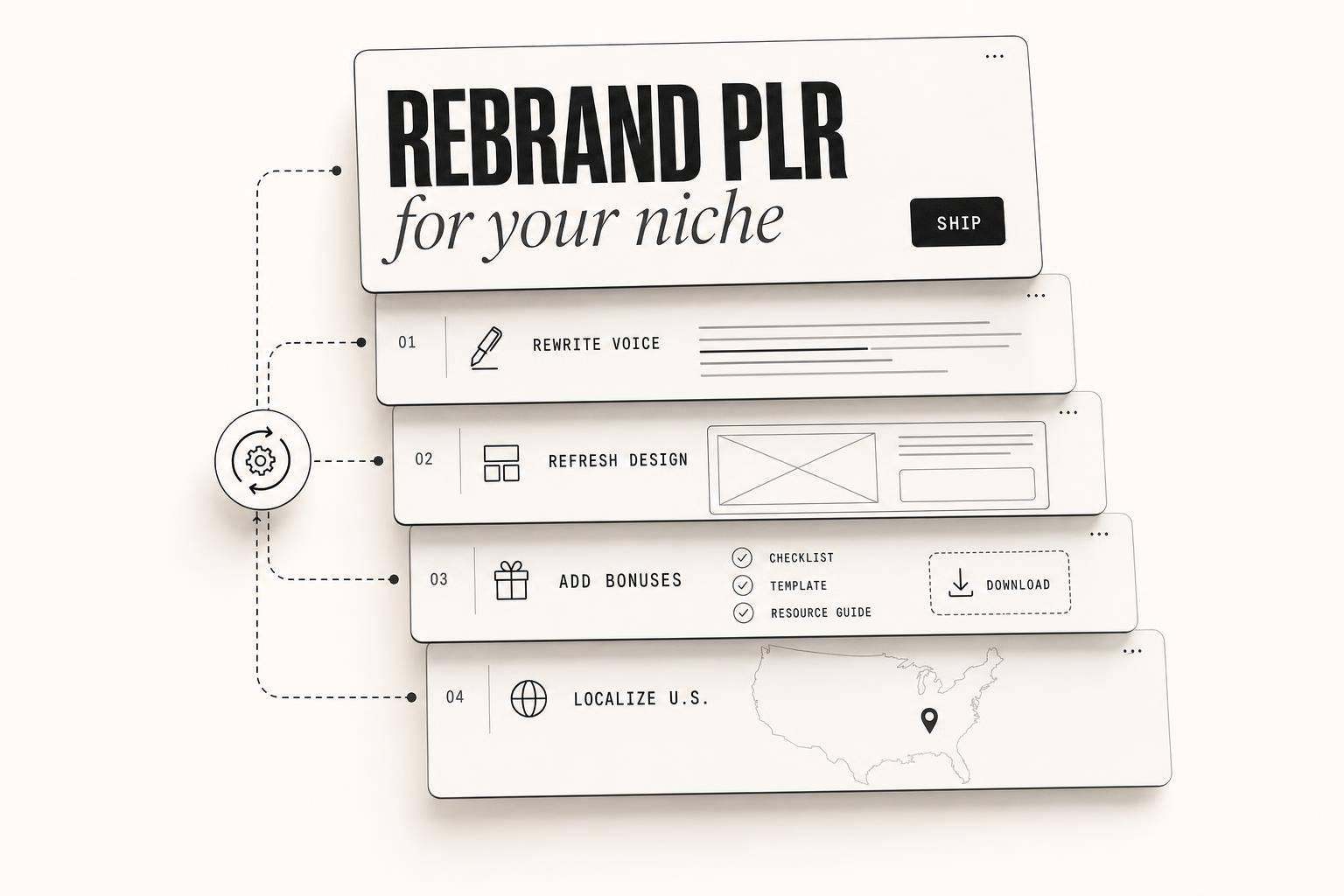
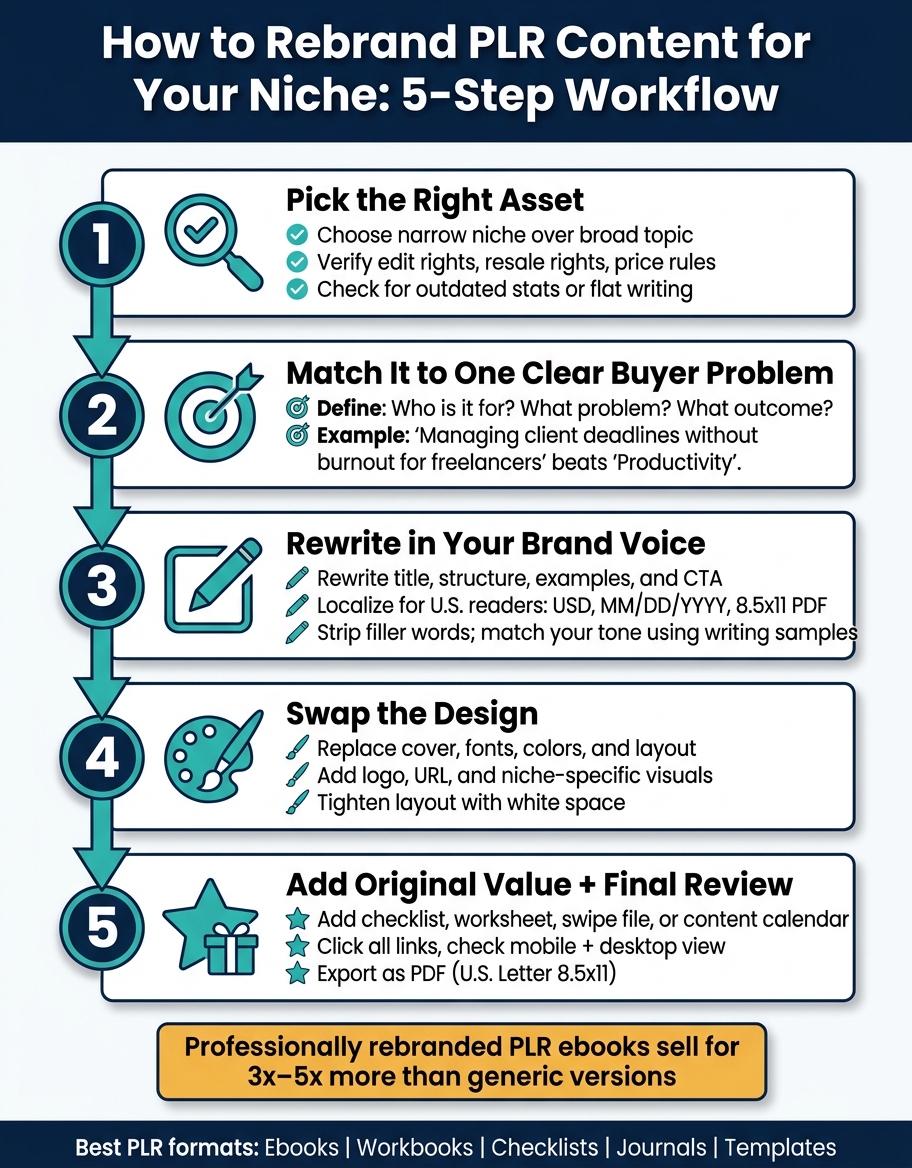
You can turn generic PLR into a niche product if you do five things: pick the right asset, match it to one clear buyer problem, rewrite it in your voice, swap the design, and add your own examples or bonus items. That is the short version.
I’d sum the process up like this:
- Start with fit, not volume. A broad topic usually falls flat. A narrow buyer problem gives you a stronger angle.
- Check the license before you touch the file. Edit rights, resale rights, and price rules can shape what you can sell.
- Rewrite more than the title. Surface edits alone do not change much. The body, examples, flow, and call to action should sound like you.
- Localize for U.S. readers. Use U.S. spelling, month-day-year dates, $USD, and 8.5 x 11-inch PDF export settings.
- Add your own material. A foreword, short case study, checklist, worksheet, or swipe file can help move a plain PDF into a paid offer.
- Use a repeatable process. A simple checklist for content, design, links, and export cuts errors and saves time.
A few points stand out from the article:
- Rebranded PLR ebooks can sell for 3x to 5x more than generic versions.
- The best PLR formats for this job are usually ebooks, workbooks, checklists, journals, and templates.
- A final review should include link checks, mobile and desktop review, visual consistency, and PDF export settings.
My takeaway: PLR works best when the original file becomes the starting draft, not the finished product.
If I were doing this, I’d treat PLR like a base layer: keep the topic, then rebuild the message, design, and offer around one niche reader and one direct result.
How to Rebrand PLR Content: 5-Step Workflow
How to Choose PLR Content That Fits Your Niche
Define Your Niche and Your Audience's Problem
Don't buy PLR until you're clear on the buyer, the problem, and the result they want. A broad topic like "productivity" is too vague to hit home. But "managing multiple client deadlines without burnout for freelancers" speaks to a clear person dealing with a clear pain point.
Before you open any PLR library, stop and answer three questions: Who is this for? What specific problem does it solve? What outcome does it lead to? That filter comes first. Use it before you look at quality, format, or design.
| Broad Topic | Micro-Niche Angle | Rebranding Angle |
|---|---|---|
| Productivity | Freelancers | Managing multiple client deadlines without burnout |
| Email Marketing | Etsy Sellers | Turning one-time shoppers into repeat customers |
| Fitness | Postpartum Moms | Finding 15-minute windows for core strength |
| Time Management | Startup Founders | Prioritizing high-impact tasks over "busy work" |
Check Content Quality and License Terms First
Even if the niche looks right, weak or restricted PLR can still sink the whole idea. Read the content once as-is before changing anything. You need to judge whether it solves a real problem, not just whether it sounds decent at first glance.
Look for old stats, dated references, or advice that no longer matches how things work now. Also watch for writing that feels correct but flat. If fixing it would take a full rewrite, you're usually better off picking a stronger source.
License terms matter just as much as the writing itself. Confirm what you're allowed to do before you buy:
- Edit rights - Can you change the content?
- Resale rights - Can you sell it to customers?
- Customer resale rights - Can your customers resell it?
Check for minimum resale price rules, limits on using the content as a free lead magnet, and whether the original author's name has to be removed. Miss those details, and you can run into legal trouble or business headaches later.
Match the Format to the Offer You Want to Sell
Once the niche and license check out, pick the format that fits the offer you want to sell. The format should line up with how your audience likes to learn and what step you want them to take next.
"Professionally rebranded PLR ebooks routinely sell for 3-5 times more than their generic counterparts. When you don't rebrand, you're leaving serious money on the table." - Entrepedia
A tight rebrand can support a higher price because the format feels built for a specific offer.
sbb-itb-e9b8513
Rewrite PLR Content to Fit Your Brand and U.S. Audience
Update the Title, Structure, and Brand Voice
Start by rewriting the title so it speaks to your audience and the result they want. Then reshape the section flow around your own method, so the piece feels like your process, not a stock draft.
Your goal here is simple: make the content sound like your brand. That might mean direct, warm, or more authoritative. Cut filler. Strip out stiff AI-style wording like "delve", "embark", and "tapestry." And rewrite enough of the piece that it feels plainly original.
A simple way to do that: paste 2–3 writing samples into Claude or ChatGPT and ask it to match your tone. That gives you a better starting point than asking for a rewrite with no reference.
After the copy sounds like your brand, shift the details so U.S. readers feel at home with it right away.
Localize the Content for U.S. Readers
Use U.S. spelling, month-day-year dates, USD prices, and U.S. customary units. If the draft mentions references that may not click with people in the United States, swap them out for ones that will.
This part matters more than people think. A reader notices small mismatches fast. If a price is in another currency or a date looks off, the content can feel imported instead of made for them.
Once the language matches your market, make the piece more useful by adding your own examples and a clear next step.
Add Your Offer, Examples, and a Clear Next Step
Replace generic calls to action with links to your opt-in, landing page, or product. Add specific examples and short personal notes so the content feels used and tested, not generic.
If you're using myAtlasLab, begin with its rebrandable ebooks, templates, and guides. Then layer in your own examples and point readers to the next action you want them to take.
When the copy sounds like your brand, update the visuals too, so the finished product looks just as tailored as the writing.
How To Edit & Rebrand a PLR Product - Full Step-By-Step Tutorial - PLR Training Camp
Rebrand the Visuals and Add Original Value
With the copy done, the last step is making the product feel like it was built by you from the start.
Replace Covers, Images, Fonts, and Layout Elements
Once the copy fits your brand, the design should do the same. Rework the cover with your brand colors, a clear title structure, and clean typography. Use the same font family as your website, carry your color palette across the document, and add your logo, URL, and contact details.
Then swap out generic stock images for visuals that fit your niche. Tighten the layout, add more white space, and make the whole thing easier to read.
Presentation shapes perceived value.
Create Companion Assets to Expand the Offer
After the cover and layout are fixed, add bonuses that make the offer feel more complete. A plain PDF can become a small product bundle with one or two companion assets, such as:
- A checklist
- A worksheet
- A swipe file
- A content calendar
Pick bonuses that solve the same problem your niche came to fix.
This is also where you can stand apart. Add Done-For-You social media graphics or an AI prompt pack tied to your niche. Those are the kinds of extras other buyers using the same PLR usually won’t include. If you're using myAtlasLab, pull from its asset library and Launch OS to put the bundle together faster.
Before and After: Original PLR vs. Rebranded Version
The difference should be obvious right away.
| Feature | Generic PLR (Before) | Rebranded Product (After) |
|---|---|---|
| Title | Generic (e.g., "Digital Marketing Guide") | Outcome-focused (e.g., "30-Day Growth Blueprint") |
| Visuals | Default stock cover, generic layout | Custom cover, brand colors, niche-specific graphics |
| Examples | Generic or no examples | Real, niche-relevant examples and personal notes |
| Added bonuses | Standalone PDF only | Product suite with checklist, workbook, or swipe file |
Build a Repeatable Rebranding Workflow and Do a Final Review
Once the copy and visuals are finished, the next move is simple: turn what you just did into a system you can use again and again. That way, each new PLR product takes less time, feels less messy, and moves from draft to published in the same order every time.
Use a Checklist, Templates, and AI to Speed Up the Process
Use the same flow for every PLR product so editing, design, and publishing don’t turn into guesswork.
- Foundation - Save the license terms and the brand voice you already defined.
- Content - Apply the rewrite pass.
- Visuals - Apply the finished branding package.
- Bonus asset - Attach the extra asset you already built.
- Publish check - Proofread, test links, and verify export settings.
This kind of checklist saves mental energy. Instead of deciding what comes next each time, you just follow the path. It’s a lot like cooking from a go-to recipe. You still make small changes, but the base process stays the same.
AI tools can also help move the content stage along. The key is to use prompts that match the voice you defined earlier. For example: "Rewrite this for a burnt-out entrepreneur using a casual, punchy tone." myAtlasLab's Launch OS and AI tools can also help with product naming, branding, and marketing materials.
Run Final Quality Checks Before Publishing
Before you export anything, do one last review for formatting, links, and device view. This final pass is boring in the best way. It catches the small stuff that can make a product feel sloppy.
- Link verification: Click every internal and external link in the document to confirm they work.
- Visual consistency: Make sure your brand colors, logo, and fonts appear the same across all pages.
- Device check: Open the file on both desktop and mobile to catch any layout issues.
- Export settings: Save the final version as a PDF formatted to U.S. Letter size (8.5 x 11 inches) for printability and digital use.
If you’re selling a higher-priced product, it also helps to share a draft with a small group of beta readers before the official launch. Their feedback on clarity and usability can spot issues you’d probably miss on your own.
Conclusion: Turn PLR into a Niche-Ready Product
When you repeat the same process, PLR becomes a faster route to niche products. The steps are clear: start with quality PLR that fits your niche, rewrite it in your brand voice, localize it for your U.S. audience, refresh the visuals, and add your own value on top. Then turn that into a repeatable workflow so each new product takes less time than the last.
"The goal is not to hide that you used PLR. The goal is to invest enough of yourself into the product that the PLR becomes the least interesting thing about it." - Devulture
Done well, a single PLR asset can become a polished, sellable product that feels like it was built from scratch - because in every way that matters to your buyer, it was.
FAQs
How much should I rewrite PLR?
You don’t have to redo the whole document to rebrand PLR content well. The smarter move is to make focused edits that have a big effect and line up with your brand voice and niche.
A good rule of thumb is to rewrite 30% to 50% of the piece. Put most of your effort into the introduction, conclusion, personal stories or anecdotes, and any old stats. Those parts do the heavy lifting when it comes to making the content feel original and helping readers trust it.
Which PLR format sells best?
No single PLR format sells best. What matters more is picking high-quality content that fits your niche and matches what your audience wants.
You can use ebooks, templates, courses, or planners. But the format alone isn’t what makes people buy. The value comes from rebranding generic content into something that feels premium and clearly yours.
That usually means adding:
- Your brand voice
- Original visuals
- Your own insights
Same base content, different presentation. That’s often the difference between something that feels generic and something people are happy to pay for.
What should I check before publishing?
Before you publish, give your rebranded PLR content one last pass. This final review helps make sure everything fits your brand and looks polished.
Check the license terms first. Then proofread for typos, awkward phrasing, and outdated references. After that, review the brand details, including your logo, colors, fonts, contact info, and calls-to-action, to make sure they’re all correct.
Once everything looks right, export the content in the proper file format and keep the file size optimized for delivery.