PLR vs. MRR: Which License Fits Your Business?
Compare PLR and MRR to decide between customization (brand control) and fast resale—always read the license terms first.
PLR vs. MRR: Which License Fits Your Business?
If I want control, I pick PLR. If I want to start selling fast, I pick MRR. That is the short answer.
Here’s the simple breakdown:
- PLR lets me edit, rebrand, rename, bundle, and set my own price in most cases.
- MRR lets me resell the product as-is, and in some cases my buyers can resell it too.
- PLR fits a brand-first model.
- MRR fits a volume-first model.
- In both cases, the license terms matter more than the label.
One fact stands out: many sellers keep 100% of each sale under both models, but the way they compete is very different. With PLR, I compete by changing the product. With MRR, I usually compete on funnel, support, bonuses, or price.
Before I sell anything, I check:
- What I can edit
- Whether I can add my name and branding
- Whether buyers get personal-use rights or resale rights
- Whether pricing rules apply
- Whether the platform allows that license type
The biggest risk is simple: if I market PLR like MRR, or assume all MRR terms are the same, I can end up with refunds, takedowns, or buyer complaints.
Quick Comparison
| Criteria | PLR | MRR |
|---|---|---|
| Edit content | Yes, usually | No, usually |
| Rebrand product | Yes | No |
| Claim authorship | Often yes | No |
| Sell to end users | Yes | Yes |
| Pass resale rights to buyers | Usually no | Sometimes yes |
| Source files included | Often yes | Often no |
| Pricing control | Usually high | Sometimes limited by terms or market pressure |
| Best fit | Brand building | Fast resale |
I see it this way: PLR gives me more room to shape the offer, while MRR gives me less setup work. The right choice depends on whether I want to build a branded catalog or move ready-made products with less product work.
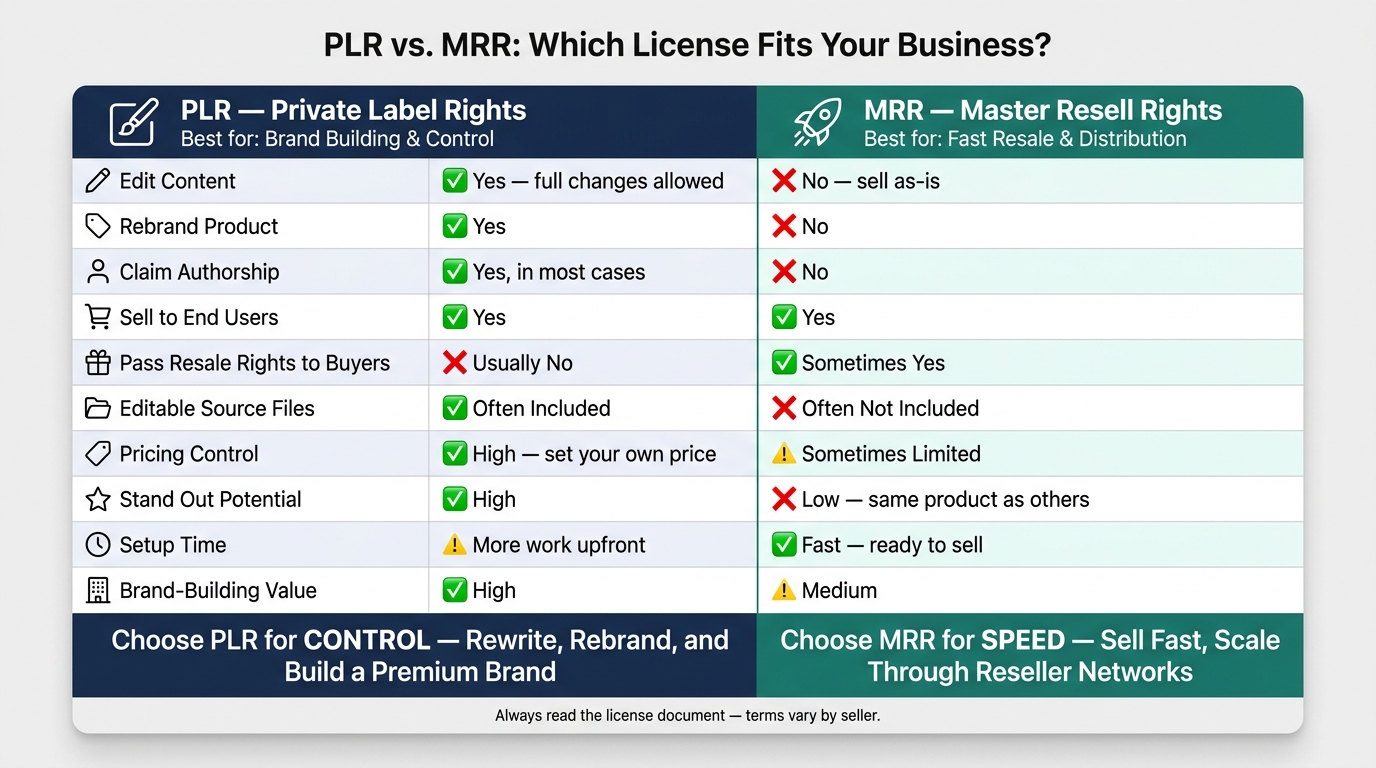
PLR vs. MRR: Side-by-Side License Comparison
PLR vs MRR vs RR Digital Products Explained | Which License is Best for Your Online Business?
sbb-itb-e9b8513
PLR Explained: Best for Custom Branding and Product Control
Private Label Rights (PLR) is a licensing model that gives you broad control over a digital product. You can edit the text, change the title, swap out graphics, and add your logo. Some licenses also let you publish the revised version under your brand. That level of control is the big draw with PLR. So the next step is simple: understand what you can change and what you can't.
PLR content is often sold as ebooks, guides, courses, templates, checklists, graphics, and video. In many cases, PLR packages include editable source files like .docx files or Canva links. That makes deep customization possible, so you can take a generic product and shape it to fit your niche, audience, and brand voice.
What PLR Typically Allows and Restricts
Most PLR licenses let you change the title, rewrite sections, update the design, bundle the product with other assets, and set your own price. In most cases, you can also sell the finished product to end-users.
A few limits matter here. You usually can't pass editing rights to your customers unless the license clearly allows it. Some licenses also limit free distribution. And in most cases, the original creator still keeps the underlying copyright, even if you've rebranded the product. Since terms change from seller to seller, read the license before you buy or resell anything.
That mix of freedom and limits is why PLR works well for brands that want control, not just speed.
PLR Pros, Cons, and Best-Fit Use Cases
PLR makes sense for creators building a branded product line. The big upside is speed: you start with a draft, then make it your own.
| PLR Pros | PLR Cons |
|---|---|
| Faster production than creating from scratch | Requires editing time and effort |
| Full control over branding and authorship | Content quality varies by provider |
| Flexible pricing - you set your own price | Risk of duplicate products in the market |
| Can bundle assets into premium offers | Cannot always transfer editing rights to buyers |
| Editable source files included | Unedited PLR hurts brand credibility |
If you've ever tried to turn rough source material into something polished, you already know where things can get messy. That's where a guided asset library starts to help.
How myAtlasLab Supports a PLR-Style Workflow
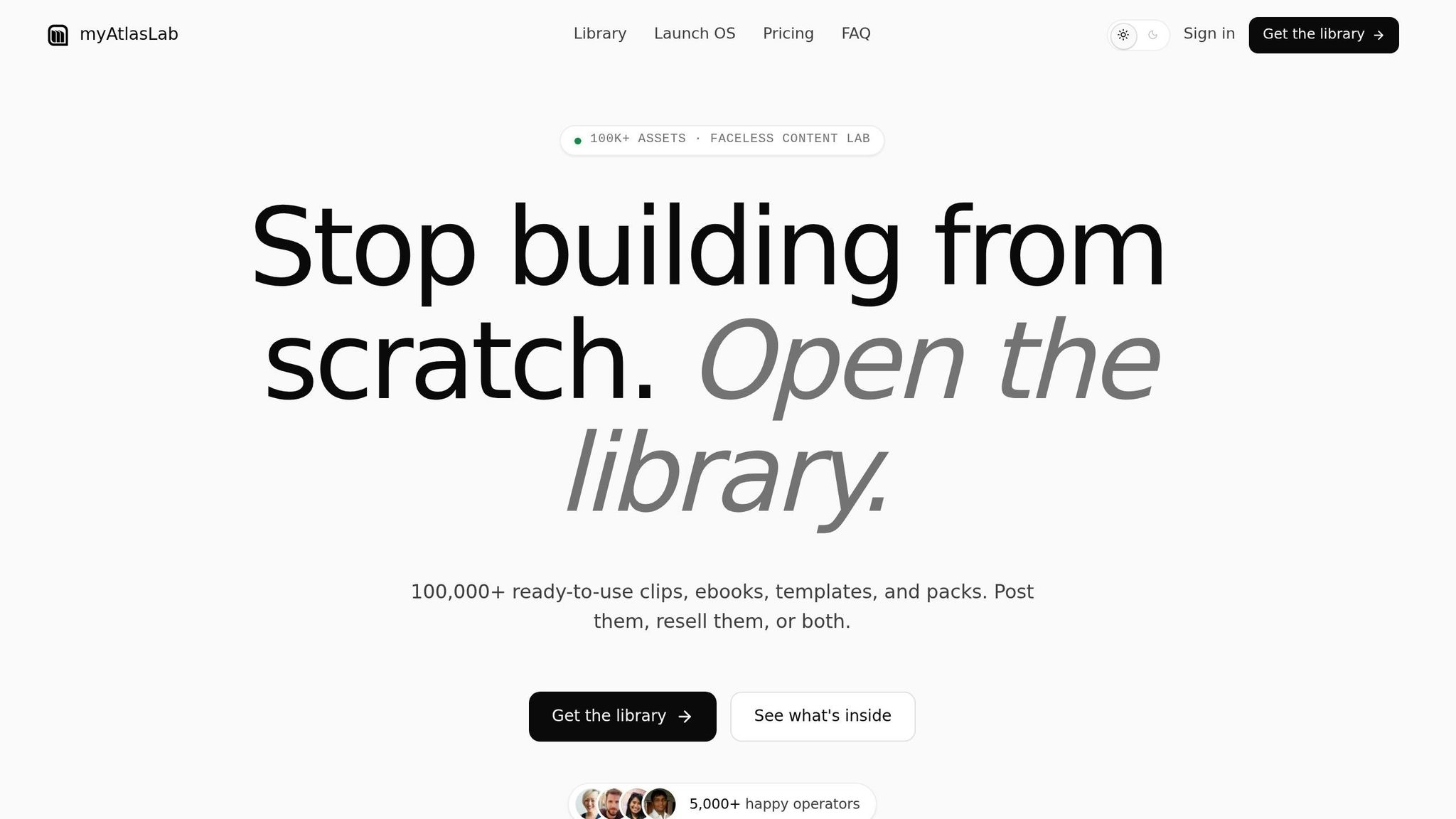
myAtlasLab supports this kind of workflow. The platform gives you access to a large library of rebrandable ebooks, guides, templates, and HD/4K clips. These assets are built to be customized and relaunched under your brand.
Launch OS adds a 10-phase workflow for rebranding and selling digital products. It walks you through each step, from the first idea to a finished offer. Its AI tools also help with product ideas, branding, and marketing.
MRR Explained: Best for Fast Resale and Reseller Distribution
If PLR is about customization, MRR is about distribution.
Master Resell Rights (MRR) lets you resell a product. In some cases, it also lets you pass resale rights to your buyers. That makes MRR a good fit for sellers who want to move products fast, not spend time rewriting, redesigning, or repackaging them.
Most MRR products are sold as-is. You usually can't edit them or rebrand them. That means less control over how the product looks and feels, but it also means a much faster setup. Files like .docx documents or editable templates are not often included, since the license doesn't allow changes anyway. The original creator keeps the copyright the whole time.
What MRR Typically Allows and Restricts
With MRR, you can sell the product over and over and keep 100% of the profit from each sale. But here's the part that trips people up: not every MRR license gives the same resale rights.
Some licenses let your customer buy the product only for personal use. Others let them resell it too. And some go a step further and allow resale to other resellers. The only way to know for sure is to read the license document itself.
What you generally cannot do includes:
- Edit the content
- Replace the author's name
- Claim you made it
- Change the branding
MRR Pros, Cons, and Best-Fit Use Cases
MRR works well for entrepreneurs who want a ready-to-sell product without spending hours building one from scratch or fixing it up. You'll often see MRR used with self-improvement eBooks, business planners, and masterclasses. These are finished products that can move fast through reseller networks.
The catch is simple: it's hard to stand out.
If everyone is selling the same file, using the same product copy, and pointing to the same sales page ideas, price becomes the main battle. And that battle gets ugly fast.
| MRR Pros | MRR Cons |
|---|---|
| Instant product inventory with no creation time | High market saturation and competition |
| Scalable passive income through reseller networks | Zero product differentiation from other sellers |
| No technical or creative skills required | No ability to build unique brand authority |
| Ideal for testing niche demand quickly | Limited control over product quality or updates |
Since MRR products are often identical, sellers usually stand apart with bonuses, customer support, or a better funnel. Without that, price pressure tends to hit hard.
Next, compare MRR with PLR on editing, branding, resale rights, and pricing control.
PLR vs. MRR: Side-by-Side Differences That Affect Revenue and Brand Growth
PLR is about control. MRR is about speed.
That’s the plain-English difference. What changes from there is how much say you have over the product you sell, how much room you have to shape it, and how easy it is to stand apart from everyone else selling something similar.
Comparison Table: Editing, Rebranding, Resale Rights, and Pricing Control
| Feature | PLR | MRR |
|---|---|---|
| Can you edit the content? | Yes - full changes allowed | No - must sell as-is |
| Can you claim authorship? | Yes, in most cases | No |
| Can customers resell it? | Typically no (end-user only) | Yes - buyers get resale rights |
| Editable source files included? | Usually yes | Typically no (PDF or MP4 only) |
| Branding freedom | High - full rebranding allowed | Low |
| Pricing control | Full - bundle, price, or give away freely | Pricing may be limited by license terms or market competition |
| How easily you can stand out | High - your version can be your own | Low - the product stays the same across resellers |
| Brand-building value | High - supports a branded asset | Medium - useful for distribution, but limited brand value |
If you want to change the copy, swap the design, add your logo, or turn one product into part of a larger offer, PLR gives you that room. MRR doesn’t. You’re selling the same core product other resellers are selling, which makes speed the big upside and differentiation the weak spot.
How Each License Shapes Your Business Model
PLR tends to work better for premium offers because you can rewrite, rebrand, and repackage the product. MRR tends to work better for volume sales because you can start selling fast without making changes.
That split shows up pretty clearly in a few common business models.
| Business Model | PLR Fit | MRR Fit |
|---|---|---|
| Course creators | High - build a branded curriculum | Low - hard to differentiate |
| Template shops | High - editable files are key | Low - static files don't work here |
| Reseller-driven offers | Low - not built for distribution chains | High - designed for reseller growth |
A course creator usually needs room to shape lessons, add brand voice, and build a product that feels tied to their business. A template shop needs files people can edit, not locked-down assets. On the flip side, if your model depends on selling through resellers, MRR is built for that path.
Legal and Practical Checks Before You Sell
Keep the original license file.
A PDF or certificate that shows your rights can save you a headache if a platform flags your product or if a dispute pops up. Bad license claims can lead to refunds, takedowns, or damage to how buyers see your brand.
Before listing anything, check a few basics:
- Confirm what your buyers get
- Review any marketplace rules
- Make sure you never market PLR as MRR
PLR usually stops at personal use for the buyer. MRR usually passes resale rights downstream. That detail matters a lot, because getting it wrong isn’t a small typo. It changes what the customer is allowed to do after purchase.
With the license terms sorted out, the next move is picking the one that lines up with how you plan to sell.
Which License Fits Your Business? A Decision Framework and Key Takeaways
A Simple Checklist for Choosing PLR or MRR
After you compare the rights, the choice comes down to control or speed.
Choose PLR for control. Choose MRR for speed.
Go with PLR if you want to rewrite, redesign, and bundle products into a branded offer. It asks for more work at the start, but it gives you room to build brand authority over time and sell offers that feel more premium.
Go with MRR if you want to sell the product as-is and put your energy into traffic instead of product work. You're giving up customization for speed, which can make sense when fast market entry and reseller distribution are the main goals.
If PLR seems like the right move but the editing side feels like a lot, myAtlasLab can help. Its 100,000+ rebrandable assets and Launch OS can cut down the time it takes to turn raw content into a branded product.
Key Points to Review Before Buying Any License
Before you buy, verify the exact rights in writing.
Read the license document, not the label.
Before you pay, check the buyer rights, resale limits, and pricing rules. Getting those details clear from the start helps protect your revenue and keeps your sales process clean.
FAQs
How do I know if PLR or MRR fits my business model?
Choose based on what you want to do with the product.
PLR works best if you plan to edit the content, add your own branding, and turn it into something that feels like yours. It gives you more room to shape the product around your business and voice.
MRR makes more sense if you want to sell the product as-is and let your buyers resell it too. It’s a better fit when you want a more hands-off setup.
Your decision also comes down to your experience level, your branding plan, and how much time you’re willing to put into making changes.
What should I check in a license before I sell the product?
Check the license closely so you know exactly what you can and can't do with the product.
You want clear permission for resale, modification, or rebranding if you plan to do any of those. If the wording is vague, that's a red flag.
Also check whether you're allowed to pass resale rights on to your customers. Read the full license before you list or sell anything. That step helps you stay compliant and steer clear of legal trouble.
Can I combine PLR products into a new branded offer?
Yes. A lot of digital product sellers mix PLR products with other assets to build an offer that feels bigger and worth more.
For example, you could pair a PLR ebook with templates and workbooks. Or bundle it with related courses or guides. That gives you room to customize and rebrand the content, make it feel like your own, and sell it as a more premium offer.