No Audience Yet? How to Start Selling Digital Products
Create simple templates, validate demand, and sell digital products without an audience using proven steps.
No Audience Yet? How to Start Selling Digital Products
You don’t need a large following to sell digital products. With options like eBooks, templates, and online courses, you can create once and sell repeatedly without worrying about inventory or shipping. The global digital products market exceeds $2.5 trillion annually, proving people will buy solutions to their problems - even from creators they don’t know.
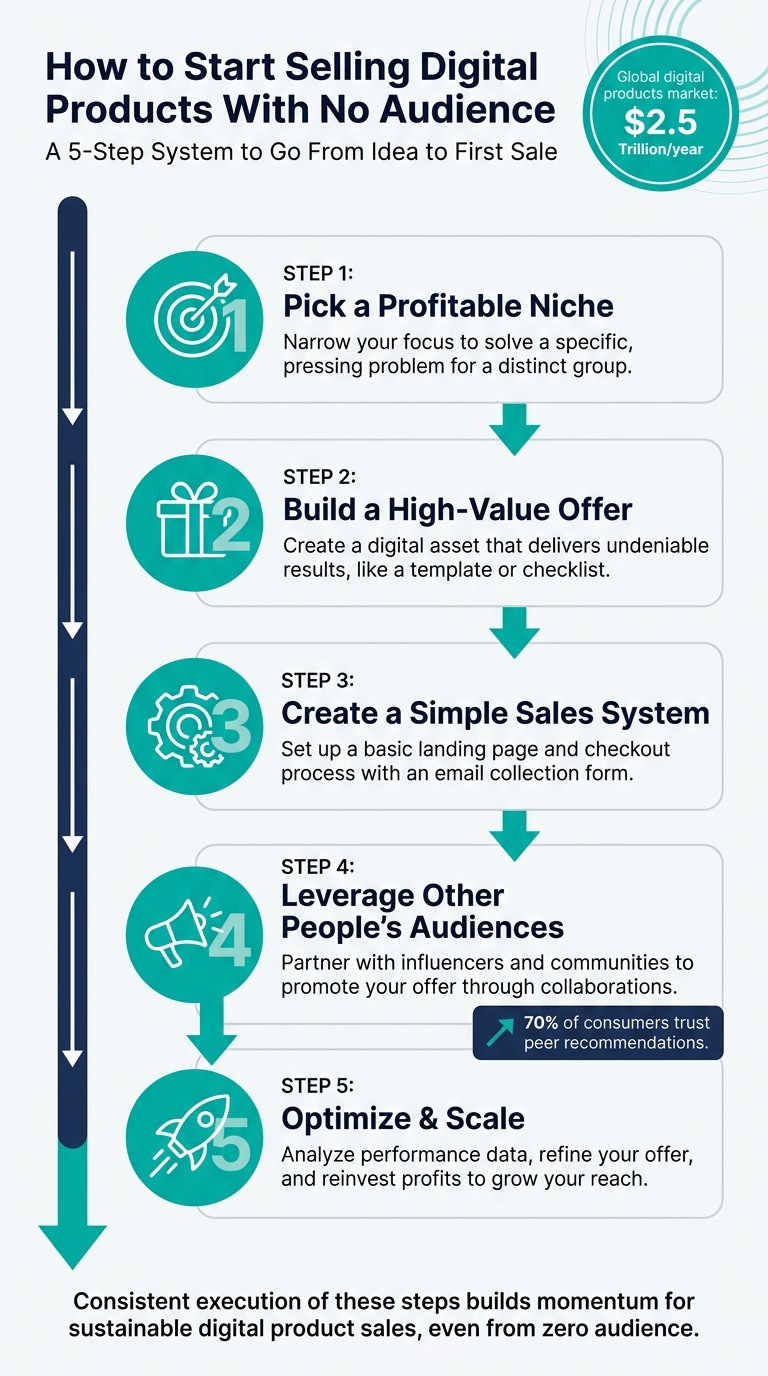
Here’s how to get started:
- Pick a profitable niche: Solve a specific, pressing problem for a defined audience.
- Validate demand: Use tools like Google Trends, Reddit, or pre-sales to confirm interest.
- Create a simple product: Start with templates, guides, or checklists - quick to make and easy to sell.
- Set up a basic sales system: Use platforms like Gumroad to handle payments and delivery.
- Drive traffic: Leverage search-friendly platforms like Medium and Pinterest to reach new audiences.
Tools like myAtlasLab can simplify the process with customizable templates, AI-powered branding, and a step-by-step launch system. The key? Focus on solving problems, test your ideas, and build momentum over time.
How to Start Selling Digital Products With No Audience (5-Step System)
How to Sell Digital Products Online (With Literally No Audience)
sbb-itb-e9b8513
Finding Your Niche and Understanding What Customers Want
When you're starting from scratch, defining a clear niche is the first priority in selling digital products. Before creating anything, you need to pinpoint who you're helping and what problem you're solving. Here's a sobering stat: an analysis of 158,441 digital products revealed that 44.6% earned absolutely $0. Skipping niche research can sink even the most well-crafted product.
What Makes a Niche Profitable?
A profitable niche targets a specific, pressing problem that buyers are eager to solve. Specificity is key. For example, "workout plans" is too generic, but "workout plans for skinny guys who hate gyms" speaks directly to a well-defined audience.
"A mediocre product in a hungry niche will outsell a brilliant product in an indifferent one. Every time." - Simon Value
Profitable niches often solve urgent, practical problems where inaction has a clear cost. Think about invoice templates tailored for independent contractors or customized Notion dashboards for freelance project managers. These practical solutions often outperform passion-based products because they address immediate needs.
Tools to Research Demand
You don’t need a massive budget to uncover market demand. Free tools like Google Trends and Reddit can be incredibly effective. Google Trends shows whether interest in a topic is growing, steady, or declining. Meanwhile, Reddit can help you spot unmet needs - look for posts starting with phrases like "How do I…", "I wish there was…", or "I keep struggling with…".
Digital marketplaces also provide clues about what people are willing to pay for. On platforms like Gumroad, only 2–5% of buyers typically leave a review. To estimate total sales, divide the number of reviews by 0.03. For example, a product with 60 reviews likely sold around 2,000 units - clear evidence of demand.
AI tools can make this process even faster. They can scan forums and marketplaces to identify recurring themes, cutting research time from 20–40 hours to as little as 3 hours. Additionally, platforms like myAtlasLab categorize assets across business, productivity, marketing, and more, offering quick snapshots of which digital products are already in demand.
Once you've gathered demand data, it’s time to assess your niche for viability.
How to Evaluate a Niche Before Committing
Before diving in, validate your niche using five key signals. These indicators can guide your product creation strategy:
| Niche Signal | Pass | Fail |
|---|---|---|
| Search Volume | 2,000+ monthly searches; stable or rising | Under 500/month; declining trends |
| Competition | 5–20 active competitors with quality gaps | Zero competitors or one dominant player |
| Pricing | Multiple products priced at $29–$99+ | Everything is free or priced under $15 |
| Audience | 2–3 active communities with 10,000+ members | No clear online gathering places |
| Validation | 10%+ landing page opt-in or 5+ pre-sales | Under 5% conversion; no pre-sales |
Finally, test your niche with a simple exercise: describe your product, its target audience, and the specific problem it solves in one sentence. If you can’t do this, your niche might be too vague. Nail that one sentence, and the rest of your product strategy will naturally fall into place.
How to Choose and Create Your First Digital Product
Once you've confirmed your niche, the next step is picking a digital product format that fits your audience. This decision is more crucial than it might seem - choosing the wrong format can make your launch more challenging than it needs to be.
Digital Product Formats That Work Well for Beginners
The format you choose should align with what your audience needs most. For example, if they're searching for quick solutions, a checklist or template might be ideal. On the other hand, if they're looking to master a new skill, a guide or mini-course could be more appropriate.
| Format | Time to Create | Price Range | Best For |
|---|---|---|---|
| Checklists / Prompt Packs | Hours | $5–$17 | Quick wins and clear processes |
| Templates / Trackers | Days | $9–$49 | Saving time and staying organized |
| eBooks / Guides | Days to weeks | $19–$97 | Providing in-depth information |
| Online Courses | Weeks to months | $97–$497+ | Teaching complex systems |
If you're just starting out, a simple template or a short guide (10–30 pages) is often the best way to go. These types of products are quick to create - sometimes over a single weekend - and don't require advanced technical skills. They also fit well into what’s known as the "impulse-buy" price range, often $17, $27, or $47, which tends to attract buyers with minimal hesitation.
"A digital product can be a simple checklist, a template, a prompt pack... that saves someone time." - Tekinemre.com
Using myAtlasLab to Build Products Faster
For many new creators, the challenge isn't coming up with ideas - it’s turning those ideas into finished products. That’s where myAtlasLab can save you a lot of time and effort. This platform offers a library of over 5,000 rebrandable eBooks, guides, templates, and HD/4K clips, all customizable and ready to sell with full commercial rights.
Once you've chosen your format, myAtlasLab’s tools can help you fine-tune every aspect of your product. Its AI features assist with branding, product ideas, and marketing copy, so you’re not left guessing. Plus, the 10-phase Launch OS, included in the Pro Lifetime plan for $147, walks you through every step - from creation to your first sale. This system is designed to help you launch a polished, ready-to-sell product quickly.
How to Package Your Product to Increase Its Value
A single file by itself rarely justifies a premium price. To boost value, consider bundling related items. For example, you could pair an eBook with templates and a short video walkthrough. Research shows that bundling products and offering upsell options can triple your average order value without needing additional traffic.
A simple way to structure this is through a 3-product system:
- Entry-level product: A low-cost item ($5–$9) to attract new buyers.
- Main product: A mid-tier offering ($15–$29) that delivers more depth.
- Bundle: A higher-value package ($29–$59) combining multiple assets.
This setup not only gives buyers an affordable starting point but also opens up opportunities for you to increase revenue. Whatever you decide to package, focus on the outcome your product delivers. As the saying goes, "Sell the result, not the file." This approach helps you test and refine your offerings while building a system that’s both scalable and profitable.
How to Validate Your Product Before You Launch
Once you've sketched out your digital product, the next step is making sure there's real demand for it. This step is crucial before you dive into full-scale development.
Why Validation Matters
The harsh truth? Most digital products fail - not because of poor execution, but because no one actually wanted them. Research shows that 97% of digital products fail because creators skip the validation process entirely. Taking the time to validate your idea can save you countless hours and resources.
Validation isn't about getting compliments; it's about proving demand. Whether it's through search activity, waitlist sign-ups, or pre-orders, the goal is to confirm that people are willing to pay for your product. As Zack Liu aptly puts it:
"If you haven't tried to sell it yet, you're not validating; you're just talking."
By testing key assumptions early - like whether people will pay your desired price - you can avoid expensive mistakes later.
Easy Ways to Test Your Product Idea
One of the simplest ways to gauge interest is by creating a "smoke test" landing page. This is a basic page that describes your product and includes a "Join Waitlist" or "Pre-order" button. If cold traffic converts at a rate of 5–10%, that's a strong sign of demand. On the other hand, a conversion rate below 2% might indicate that your messaging needs work or the problem you're solving isn't pressing enough.
Another quick method is competitor review mining. Check out 3-star reviews of similar products on platforms like Etsy or Gumroad. These reviews often point out what buyers felt was missing - essentially giving you a cheat sheet for improving your product.
You can also pre-sell your product at a discount to validate demand. Pre-sales from strangers - people who don't know you personally - are a strong indicator that your idea has legs. Tools like myAtlasLab make it easy to set up pre-sales and collect feedback from competitors' customers. Plus, their ready-made resources like eBooks and templates help you create a polished prototype without spending weeks on development.
Once you've gathered some early signals of interest, it's time to analyze the feedback and refine your approach.
Interpreting Feedback and Refining Your Idea
Actions speak louder than words. A friend saying, "That sounds cool", doesn't mean much. But a stranger joining your waitlist or paying for early access? That’s the kind of feedback that matters.
On your waitlist's thank-you page, include a simple question like, "What's the #1 question you want me to cover?" If at least 30% of respondents indicate they're "likely" or "very likely" to buy at your target price, you're on the right track.
If feedback highlights confusion - about your product's purpose, audience, or outcomes - don't panic. Instead of scrapping your idea, focus on tightening your messaging. Small tweaks to your headline, format, or pricing can make a big difference before your public launch.
Setting Up a Simple System to Sell Your Product
Once you've validated your product idea, the next step is creating a straightforward system to accept payments and deliver your product seamlessly.
The Basic Components of a Digital Product Sales System
To start selling, you only need three essentials: a sales page, a payment and delivery system, and an email list. Your sales page should focus on the buyer's desired outcome rather than just listing features. For example, "How to book 10 discovery calls in 30 days" is far more compelling than "12-page PDF guide." Framing it this way resonates better, especially with cold audiences.
For handling payments and product delivery, platforms like Gumroad are excellent options. Gumroad simplifies the process by combining payment and delivery into one platform and charges a 10% fee. While this fee is reasonable for beginners, you can explore lower-cost alternatives once you're consistently earning between $5,000 and $10,000. For your first product, pricing it between $7 and $27 is ideal - it minimizes buyer hesitation, especially when you're just starting out.
Set up a simple 3-email sequence to enhance the buyer's experience:
- Email 1: Deliver the product immediately.
- Email 2: Check in on day 3 to ensure they're satisfied.
- Email 3: Follow up on day 7 to request feedback or testimonials.
This process not only reduces buyer's remorse but also helps you gather early testimonials.
Next, you'll need to focus on driving traffic to your product, even if you're starting from scratch without an audience.
How to Get Traffic Without an Existing Audience
Once your sales system is ready, the challenge is attracting the right audience. Here's the mindset shift you need:
"You don't need to own an audience to launch - you need to launch into an audience that already exists somewhere else." - Josh, Founder, Built By Josh Studio
This means publishing content on platforms where potential buyers are already searching. Medium is a great starting point. Its high domain authority helps articles rank well on Google, making it perfect for beginners with no followers. For instance, in April 2026, creator Travis Nicholson earned over $26,000 by writing Medium articles on trending AI topics and linking them to his $9 prompt packs on Gumroad. He published over 200 articles, creating a snowball effect that kept driving traffic over time.
Pinterest is another powerful tool. Unlike Instagram posts that fade within 48 hours, Pinterest pins can drive traffic for years. The secret is to solve specific, searchable problems. For example, a title like "Canva templates for real estate agents" will perform much better than something vague like "design templates."
Using AI and myAtlasLab to Market Your Product
Once your sales system is in place, AI can make marketing much easier. One of the biggest hurdles for new creators is starting from scratch, and AI tools like ChatGPT can eliminate that roadblock. In a single session, you can draft sales page copy, write descriptions for 10 Pinterest pins, and create your 3-email delivery sequence.
"One good session with AI can produce enough Pinterest content to cover you for a month. That's worth doing even if social media isn't your main traffic strategy." - Steph Jordan, Mayhem to Money
For even more support, tools like myAtlasLab provide a library of over 5,000 rebrandable eBooks, templates, and guides. Instead of designing a lead magnet from the ground up, you can quickly customize a polished template and start building your email list before launching your paid product. Additionally, myAtlasLab's AI tools assist with everything from brainstorming product ideas to optimizing SEO and drafting marketing copy - all in one place. For those who prefer a step-by-step approach, the platform's 10-phase Launch OS guides you through the entire process of product creation and sales setup.
Conclusion: Start Small and Grow From There
Starting without an audience isn’t a roadblock - it’s the beginning of your journey. Every day, cold buyers find products through platforms like Google, Pinterest, and YouTube, even if they’ve never heard of the creator. The key is simple: your product must address a specific, searchable problem and connect with the people who need it most.
The way forward is straightforward. Pick a focused niche, create a simple product over a weekend, test it quickly, and set up a basic system to start selling.
"Done and published beats perfect and stuck in drafts. Every time." - Steph Jordan, Mayhem to Money
Consistency is your best ally. A single Pinterest pin or Medium article shared today can keep driving traffic and sales for months. With digital products offering profit margins between 90% and 95% after platform fees, even small sales can snowball into meaningful revenue. As you expand your product offerings - from a $9 starter item to a $97 premium guide - each customer becomes a potential repeat buyer. Streamline your process and maximize these opportunities by using the right tools.
myAtlasLab simplifies every step of the journey, from creating and marketing to refining your product. Whether it’s customizing a rebrandable eBook from a library of over 5,000 assets, drafting marketing copy with AI, or following the step-by-step Launch OS, you don’t need to start from scratch. The goal isn’t perfection on day one - it’s about solving a real problem, getting your solution into the hands of those who need it, and improving as you go.
FAQs
How do I pick a niche if I have multiple interests?
To succeed, focus on where your skills and passions intersect with a market that’s ready to invest. A useful tool here is the skills-passion matrix, which helps pinpoint areas with the greatest potential. Consider your own background - industries you’ve worked in, communities you’re connected to, or problems you’ve experienced firsthand. This perspective can guide you toward a niche where you can address a specific, pressing issue.
Before committing, make sure there’s real demand. Are people actively searching for and paying for solutions in this area? If yes, you’re on the right track.
What’s the fastest digital product to create and sell first?
The fastest digital products to create are straightforward, useful tools that solve a clear problem. Ideal choices for beginners include templates, checklists, planners, trackers, or short PDF guides. These can often be put together in just a few hours using tools like Canva or Google Sheets. Once ready, you can upload your file to platforms like Gumroad or Payhip and start selling almost immediately.
How can I get my first buyers without an audience?
To connect with potential customers, it's smart to meet them where they're already looking for solutions. Here are some practical ways to make that happen:
- Leverage platforms with built-in traffic: Sites like Etsy or Gumroad already have audiences searching for products. Listing your product there can give you instant visibility without needing to build your own audience from scratch.
- Create content for search engines: Platforms like Google and Pinterest are powerful tools for answering common questions your target audience might have. By producing helpful, keyword-focused content, you can attract people searching for solutions that your product offers.
- Engage in niche communities: Whether it's Reddit, Facebook groups, or other online forums, participating in discussions where your audience hangs out can be a game-changer. Start by offering genuine advice and insights before introducing your product - this builds trust and credibility.
Finally, make sure your product page does the heavy lifting. Clearly define the problem your product solves, explain how it provides the solution, and include a strong, compelling call to action. This combination can guide potential customers toward making a purchase.