How to Sell Digital Products Without Creating Them
Three ways to sell digital products without creating them: resell PLR, affiliate marketing, or digital dropshipping, plus licensing and delivery tips.
How to Sell Digital Products Without Creating Them
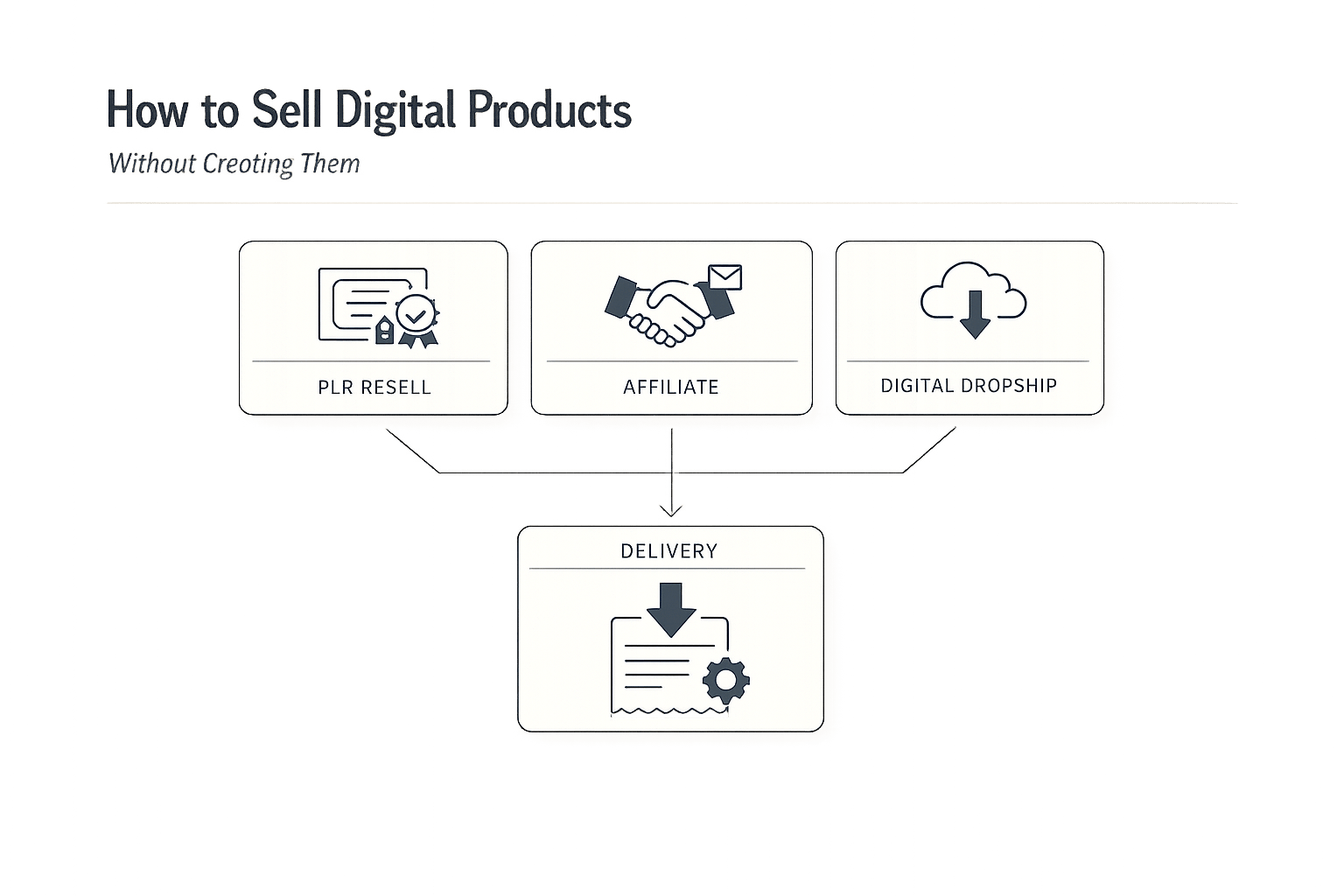
You can sell digital products without creating them by using three simple methods:
- Reselling licensed products: Buy rights to pre-made content (like PLR or MRR products), rebrand it, and sell it as your own.
- Affiliate marketing: Promote someone else’s product and earn a commission (usually 20–50%) per sale. The product creator handles delivery and support.
- Digital dropshipping: List third-party digital products in your store. When a customer buys, the product is delivered automatically.
These strategies avoid the need for inventory, shipping, or manufacturing, and typically offer profit margins of 70–95%. However, legal compliance is critical - ensure proper licensing to avoid copyright issues, and understand sales tax rules in the U.S. (like economic nexus thresholds). By picking a niche, sourcing high-quality products, and automating delivery, you can quickly build a profitable business. Platforms like Gumroad, Lemon Squeezy, or myAtlasLab can simplify setup for beginners.
3 Ways to Sell Digital Products Without Creating Them: Business Model Comparison
Step 1: Pick Your Business Model and Niche
Your first step is deciding how you'll sell and what you'll sell. These choices set the stage for your startup expenses, profit margins, and overall strategy.
Know Your Business Model Options
There are three main business models to consider, each with its own approach:
- Reselling licensed products (PLR/MRR): This model involves purchasing the rights to pre-made digital products like ebooks, templates, or courses. With Private Label Rights (PLR), you can fully customize the content, including branding it with your name. Master Resell Rights (MRR) allow you to sell the product as-is, sometimes granting your buyers the right to resell it too. Margins are high - typically 80%–95% - since your primary cost is the initial license fee.
- Affiliate marketing: This is the easiest way to get started. You promote someone else's product using a unique link and earn a commission for every sale, usually between 20% and 50%. You don’t handle product delivery or customer service, but you also have no control over pricing, branding, or access to customer data.
- Digital dropshipping: This approach blends elements of the other two. You list third-party digital products in your store, and when a customer buys, the product is delivered automatically. You maintain the customer relationship and data, but you usually can’t rebrand or modify the product.
"Digital products are the ultimate leverage play. You create once and sell infinitely - that's the kind of economics that lets small teams compete with enterprise companies." - Noah Kagan, Founder, AppSumo
Once you've picked a business model, the next step is narrowing down your niche.
Find a Profitable Niche
Choosing a niche is all about confirming demand before spending money. Start by using Google Trends to see if interest in your topic is steady or declining. Then, explore Etsy’s autocomplete feature to find popular search terms, and check platforms like Reddit or Quora for recurring questions that your product could address.
Specific niches tend to perform better in the U.S. market. For example, a general productivity planner faces stiff competition, but something like "a habit tracker for nursing students" or "a debt payoff tracker for single parents" targets a more defined audience with less competition. North America contributes about 32% of global digital product revenue, so the market is large, but the most profitable niches are often very specific.
Currently, some of the strongest demand in the U.S. is in categories like:
- Personal finance: Products like debt trackers or savings challenges.
- Online business: Tools such as AI prompt packs or social media templates.
- Health and wellness: Items like mental health journals or meal plans.
These niches address ongoing needs rather than fleeting trends, making them more dependable for consistent income.
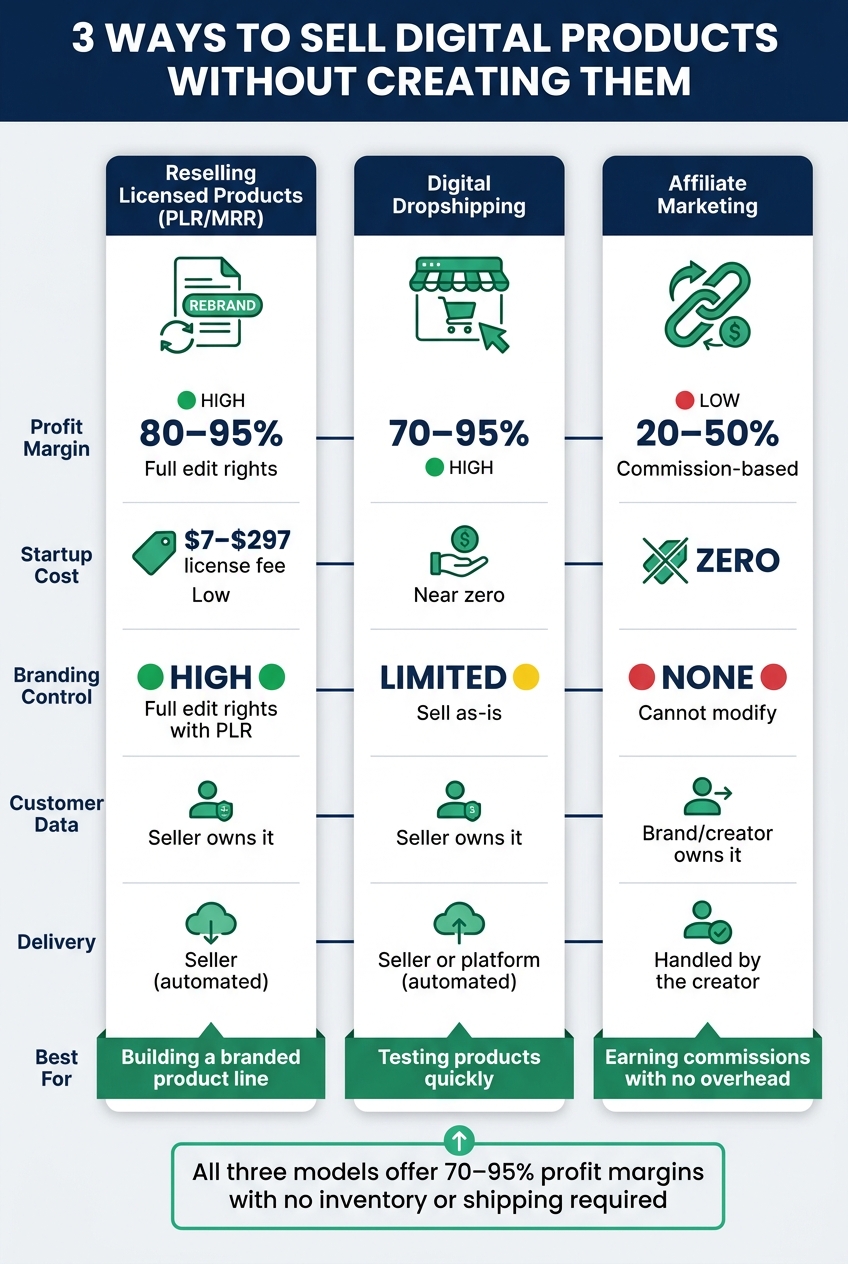
Business Model Comparison Table
Here’s a quick comparison to help you align your goals with the right business model:
| Factor | Reselling (PLR/MRR) | Digital Dropshipping | Affiliate Marketing |
|---|---|---|---|
| Profit Margin | 80–95% | 70–95% | Commission-based (20–50%) |
| Startup Cost | Low (license fee: $7–$297) | Near zero | Zero |
| Branding Control | High (full edit rights with PLR) | Limited (usually sell as-is) | None |
| Customer Data | Seller owns it | Seller owns it | Brand/creator owns it |
| Delivery Responsibility | Seller (automated) | Seller or platform (automated) | Handled by the creator |
| Best For | Building a branded product line | Testing products quickly | Earning commissions with no overhead |
sbb-itb-e9b8513
Step 2: Source Digital Products the Right Way
Once you've chosen your business model and niche, the next step is finding high-quality products you can legally sell. Understanding licensing is a critical part of this process. Before spending any money, make sure you know exactly what each license type allows you to do.
Know the License Types
Licenses dictate how you can use, modify, and resell digital products.
| License Type | Edit/Rebrand | Claim Authorship | Buyers Can Resell | Best Use Case |
|---|---|---|---|---|
| PLR (Private Label Rights) | Yes, full customization | Yes | Typically no | Brand building & creating unique offers |
| MRR (Master Resell Rights) | No, sell as-is | No | Yes | Building scalable reseller networks |
| RR (Resell Rights) | No, sell as-is | No | No | Simple one-time sales |
| Commercial Use License | Use in new products only | No | No | Incorporating design assets into new creations |
For example, MRR allows you to resell the product and pass resale rights to your buyers, but you cannot alter the original product. On the other hand, RR is the strictest: you can only sell the product once to an end-user, and they cannot resell it further.
A good rule to follow: always customize 20–50% of any PLR product before selling it. Selling unmodified PLR files often leads to heavy competition and razor-thin profit margins.
"Ready-made does not mean ready-to-rank. It definitely does not mean ready-to-convert. If your store looks like 200 other stores selling the same recycled files, your margins disappear fast." - Curtis Blackmore
Additionally, California's AB 2426 law, effective in 2025/2026, will require clear digital license disclosures on product pages. If you're selling to U.S. customers, make sure your product descriptions clearly state the rights buyers will receive.
With this knowledge, you can confidently source products that align with your business goals.
Use myAtlasLab to Source Products
With a clear understanding of licensing, platforms like myAtlasLab can simplify your product sourcing. This platform is tailored for digital product resellers and offers a library of 5,000+ rebrandable ebooks and guides, plus templates for lead magnets, content calendars, and more - all with full commercial rights. You won’t need to dig through fine print to figure out what’s allowed.
What makes myAtlasLab particularly useful is its combination of ready-to-use assets and integrated AI tools. These tools help you brainstorm product ideas, refine your branding, and even create marketing copy without leaving the platform. For beginners, the 10-phase Launch OS (available with the Pro Lifetime plan for a one-time cost of $147) provides step-by-step guidance from sourcing to selling. The library is also updated weekly, so you'll always have access to fresh material.
If you're targeting video content or social media, the platform includes 100,000+ HD/4K clips across 50+ niches, which can be bundled into content packages or offered as bonuses to enhance the perceived value of your main product.
Find and Vet Affiliate Products
In addition to licensed products, consider adding affiliate marketing to your strategy. Affiliate programs can complement your digital product business, but success depends on selecting high-quality opportunities. The U.S. affiliate marketing industry generates over $17 billion annually, with most revenue concentrated among sellers who carefully choose what to promote.
Look for programs offering at least a 10% commission or $20 per sale. SaaS products are particularly attractive, as many offer 20–50% recurring commissions, meaning you earn a percentage every month the customer remains subscribed. By contrast, Amazon Associates pays an average of 4%, which requires significant traffic to achieve meaningful earnings.
Before joining a program, evaluate two key factors:
- Earnings Per Click (EPC): This metric shows how much revenue the program generates per visitor you send.
- Compliance with FTC Rules: U.S. law requires clear affiliate disclosures, and failing to comply can result in fines of up to $50,000 per violation. Make sure your disclosure is prominently placed near the top of your content, not buried in a footer.
Step 3: Rebrand, Package, and Price Your Products
Once you’ve secured quality products, the next step is tailoring them to suit the U.S. market. Customization is key to making your products stand out and capturing the interest of U.S. buyers. The way you brand and present your products plays a huge role in determining your success.
Rebrand Products for U.S. Buyers
Platforms like Etsy and Gumroad demand original or uniquely branded content, making customization a must-do rather than a nice-to-have. Start by adapting the basics: adjust PDF layouts to the standard U.S. letter size (8.5" x 11"), replace generic data with updated U.S.-specific statistics, and rewrite examples to better connect with your audience.
Consistency is crucial. Stick to a unified color palette, use matching fonts, and maintain a cohesive design across all your materials - whether it’s an ebook, lead magnet, or sales page. As Boundless PLR explains:
"A generic template becomes a premium digital product the moment it reflects [your] identity."
Take it further by refreshing product titles, updating visuals, and revising key sections. These changes turn a basic product into something that feels tailored and valuable. Once your product is polished, think about how to package it in ways that maximize its appeal and perceived value.
Build Product Bundles and Tiers
After rebranding, consider bundling your products to increase their perceived value and encourage higher spending. For instance, instead of selling a $29 ebook as a standalone item, offer a $97 bundle that includes the ebook, a companion workbook, and a checklist. This approach not only provides more value but also entices customers to spend more. Research shows that customers who purchase a digital product are six times more likely to buy a second, higher-priced product.
Creating a product ladder - offering different tiers of value - can be a game-changer. Here’s a simple way to structure your tiers:
| Tier | Price Range (USD) | What to Include | Who It's For |
|---|---|---|---|
| Entry-Level | $29 – $59 | Templates, checklists, mini-guides | Impulse buyers, beginners |
| Core Product | $79 – $149 | Advanced toolkits, full ebooks, workbooks | Serious learners, problem-solvers |
| Premium | $199 – $499 | Bundles plus community access or coaching | High-intent buyers, professionals |
A smart trick? Present the most expensive option first. This anchors the perceived value of your offerings, making mid-tier products seem like a great deal in comparison.
Set Prices That Work
Digital products often come with profit margins of 80%–95%, so pricing is all about aligning cost with the value your product delivers.
One effective approach is charm pricing - setting prices that end in "7" (e.g., $27, $47, $97). For example, a $97 toolkit feels significantly more affordable than $100, even though the difference is just $3. Research backs this up: products priced between $47 and $97 generate 3.2 times more revenue than those priced under $20.
It’s also smart to revisit your pricing regularly. Review sales performance every 30–60 days. If a product is selling quickly but overall revenue feels stagnant, try bumping the price by 10–20% and see if sales remain steady. Many sellers start too low and unknowingly miss out on potential profits.
Step 4: Set Up Sales Channels and Automate Delivery
Once your products are tailored for the U.S. market, the next step is getting them in front of buyers and ensuring smooth delivery. Choosing the right sales platform and automating the delivery process will save you time, maximize profits, and help with compliance.
Choose the Right Sales Platform
One of the first decisions you'll need to make is whether to use a Merchant of Record (MoR) platform or go the self-hosted route. MoR platforms, like Gumroad and Lemon Squeezy, handle tricky tasks like sales tax collection and remittance across over 12,000 U.S. jurisdictions automatically. On the other hand, self-hosted platforms like Shopify leave those responsibilities to you, which can add extra costs. For example, Shopify charges $75 per tax return for users on its Basic and Advanced plans.
"The selection of an optimal platform is no longer merely a functional choice regarding digital file delivery; it is a fundamental financial and legal decision." - Arjan KC, Author
Here’s a comparison of some popular platforms for U.S. digital product sellers:
| Platform | Base Fee | Payout Schedule | Max File Size | Key Feature |
|---|---|---|---|---|
| Gumroad | 10% + $0.50 | Weekly (Fridays) | 16 GB | Merchant of Record |
| Lemon Squeezy | 5% + $0.50 | 14th & 28th | 2 GB | 0% U.S. bank payout fee |
| Stan Store | $29–$99/mo | 2–7 days | 4 GB | Link-in-bio specialist |
| Payhip | 0%–5% | Daily (via Stripe) | 5 GB | Social discount tools |
| SendOwl | $15+/mo | Instant (via Stripe) | Plan-based | PDF stamping/security |
| Shopify | $39+/mo | Daily/Weekly | 5 GB | Enterprise scalability |
A good rule of thumb: if your store starts generating $1,000/month or more in revenue, consider switching from a percentage-based platform (like Gumroad) to a flat-fee or self-hosted model to keep more of your earnings.
Once you’ve chosen your platform, the next focus is delivering your files efficiently.
Prepare and Deliver Your Files
How you package and deliver files can make or break the customer experience. For products with multiple assets, use a ZIP folder with clearly labeled subfolders so buyers can quickly locate what they need. For single items like guides or templates, a compressed PDF is ideal. To keep file sizes manageable, optimize any images you include.
As of 2026, many buyers prefer "digital locker" access over downloading large ZIP files, especially on mobile devices. If your platform supports it, allow customers to download individual files instead of forcing bulk downloads. For products like Notion templates or Canva designs, include a short "Getting Started" PDF with access links and step-by-step duplication instructions. This simple addition can significantly reduce common support questions.
For premium products, consider using platforms like SendOwl, which offer PDF stamping. This feature embeds the buyer's email address on every page, discouraging unauthorized sharing.
Once your file delivery is sorted, it’s time to automate the entire sales process.
Automate Your Sales Process
Automation is key to running a hands-off store. Set up instant confirmation emails, secure download links, and a follow-up email about two weeks after purchase to encourage customer reviews and boost your marketplace visibility.
For more advanced automation, tools like myAtlasLab's Launch OS can help. This platform not only assists with sourcing but also walks you through setting up workflows for post-purchase communications, tagging customers for follow-up marketing, and integrating your delivery system. This ensures your store runs smoothly from the very first sale.
Step 5: Drive Traffic and Grow Your Sales
With your store up and running and delivery automated, the next challenge is getting buyers to your product pages. While driving traffic doesn’t have to be overly complex, it does need to be deliberate.
Get Organic Traffic
The key to steady traffic lies in creating content that lasts - think blog posts, tutorials, and guides that address your audience’s questions. A smart keyword strategy can make all the difference. Use a three-tier approach:
- Transactional keywords: These target buyers ready to purchase, like "download budget planner template."
- Comparison keywords: These help buyers weighing options, such as "best Notion templates for freelancers."
- Problem-aware keywords: These address broader concerns, like "how to organize my finances."
Each keyword type aligns with a different stage of the buyer’s journey, giving you multiple ways to connect with potential customers.
Build a content ecosystem with various entry points, and use internal links to guide readers from your posts to your product pages. This not only improves user experience but also boosts your rankings.
"The difference between a product page that earns $0 and one that earns $5,000 often starts with a single keyword decision." - InsightRaider Research
Don’t overlook the importance of detailed product descriptions. Data shows that products with descriptions exceeding 5,000 characters generate 20x more revenue than those with less than 500 characters. Go beyond listing features: answer real buyer questions like "Will this work with my existing tools?" to build trust and encourage purchases.
"The posts that make money and the posts that get likes are often not the same posts - and without a system to track both, you'll optimize for the wrong one." - Angelica, Content Hall
Once your organic strategy is in place, you can amplify your efforts with paid ads and partnerships.
Use Paid Ads and Partnerships
Paid ads are most effective after you’ve validated your product through organic sales. Testing ads on an unproven funnel can be a costly learning experience. When you’re ready, choose platforms that align with your product:
- Google Ads: Ideal for high-intent searches like "Notion OKR template."
- TikTok and Instagram Reels: Better for visually appealing, impulse-buy products like aesthetic digital planners.
Consider using a tripwire strategy: offer a low-cost product (priced between $7–$37) immediately after a free opt-in. This approach quickly converts browsers into buyers and offsets ad costs before they even reach your main offer. For retargeting, expect conversion rates around 15%, compared to just 2% for cold traffic.
Partnerships can often outperform ads. Collaborate with newsletter owners, podcasters, or creators in related niches for joint promotions or audience swaps. These partnerships leverage pre-existing trust, making conversions nearly effortless. For example, affiliate partnerships average a 6.8% conversion rate - more than double the platform average of 3.2%.
By combining organic efforts with well-timed paid ads and partnerships, you can accelerate your sales growth.
Track Results and Improve
To make your traffic strategies more effective, focus on tracking key metrics like conversion rates, refund rates, average order value, and revenue per visitor. Use UTM parameters to monitor traffic sources and set up a simple dashboard to keep an eye on performance from organic, paid, and affiliate channels. In GA4, create custom channel groupings to track traffic from AI tools like ChatGPT and Perplexity, which often appear as "Direct" but can convert at much higher rates than standard organic traffic.
Every six months, review your top-performing content and update it. Refreshing older posts is one of the quickest ways to regain lost rankings and continue building organic growth over time. Use insights from both your organic content and paid campaigns to refine and optimize your strategy.
Conclusion: Next Steps for Selling Digital Products
You don’t have to create a product from the ground up to build a successful digital business. Instead, pick a business model, rebrand licensed products, establish your sales channels, automate delivery, and focus on driving traffic through content, ads, and partnerships.
The real challenge isn’t the strategy - it’s the technical setup. That’s where myAtlasLab comes in. With access to over 5,000 rebrandable ebooks and guides, 100,000+ HD/4K clips, and a 10-phase Launch OS, it simplifies the process. Their built-in AI tools handle product ideas, branding, and SEO, giving you a head start so you can concentrate on marketing and sales instead of getting bogged down in setup.
"The real money in PLR comes from transformation, not duplication." - Resell Ready
Once the technical hurdles are out of the way, the earning potential is impressive. Profit margins typically range from 80%–95%. New sellers can start by making $500+ per month, while those with experience - using bundles and paid ads - often achieve $5,000–$10,000 monthly after optimizing their sales funnels.
Start small: choose a niche, list a single product, and work toward your first sale. From there, scale up by introducing bundles, upsells, email campaigns, and paid advertising.
FAQs
How do I know a PLR license lets me rebrand and resell?
When you’re checking your rights, take a close look at the license that comes with the product. While most Private Label Rights (PLR) content allows you to rebrand and resell, the specific terms can differ. Make sure the license clearly states that you have commercial rights to edit, modify, and even claim authorship. Also, check for any restrictions - it might limit how you price the product, where you can sell it, or whether you can bundle it with other items. Double-check these details before buying to make sure the license aligns with your business goals.
Do I need to collect U.S. sales tax on digital downloads?
Under U.S. law, businesses are required to collect and remit sales tax in states where they have an economic nexus. This nexus is usually established when your sales or the number of transactions surpass a specific threshold set by a state. Navigating these compliance requirements can feel overwhelming, but there are ways to make the process easier. For instance, you can rely on a Merchant of Record to manage taxes on your behalf, or if you're using a self-hosted platform, automated tax software can take care of the heavy lifting.
What’s the fastest way to get traffic to my first product?
The fastest way to drive traffic to your first product is by showcasing it on well-known platforms like Etsy or Gumroad. These marketplaces already draw in massive audiences, allowing you to bypass the challenge of building your own audience from the ground up. To increase your product's visibility, focus on keyword optimization - craft titles that match what potential buyers are searching for.
If you're working as an affiliate, you can direct traffic to your product using your unique link, leveraging a tested and high-converting sales system to maximize results.