10 Digital Products You Can Rebrand and Sell Today
Skip creation - rebrand PLR eBooks, templates, courses and toolkits into niche-focused, high-margin digital products ready to sell.
10 Digital Products You Can Rebrand and Sell Today
Want to sell digital products without starting from scratch? Rebrandable products like eBooks, templates, and courses let you skip the hard work of creating from zero. These products come with licenses, such as Private Label Rights (PLR), allowing you to edit and resell them as your own. With profit margins as high as 80–95% and no inventory or shipping costs, this is a low-risk, high-reward business model.
Here’s a quick rundown of 10 digital products you can rebrand and sell:
- eBooks: Edit prewritten books, add custom covers, and bundle with extras for higher value.
- Templates and Planners: Quickly customize designs for niches like budgeting or productivity.
- Mini Courses: Transform PLR material into niche-focused online courses.
- Email Sequences: Personalize prewritten emails for marketing campaigns.
- Social Media Packs: Tweak captions and visuals for specific industries or themes.
- Stock Video Clips: Repackage video bundles for creators or businesses.
- Canva Templates: Create niche-specific kits for social media, branding, or events.
- Printables: Offer planners, trackers, or worksheets tailored to specific needs.
- Notion Dashboards: Build all-in-one productivity systems for freelancers or businesses.
- Toolkits and Bundles: Combine templates, guides, and checklists into targeted packages.
Pro Tip: Rebrand 30–50% of the content to make it stand out. Use tools like Canva or AI copywriters to update visuals and text. Platforms like myAtlasLab provide access to thousands of rebrandable resources, helping you get started fast. With the right tweaks, you can turn these products into high-demand solutions for your audience.
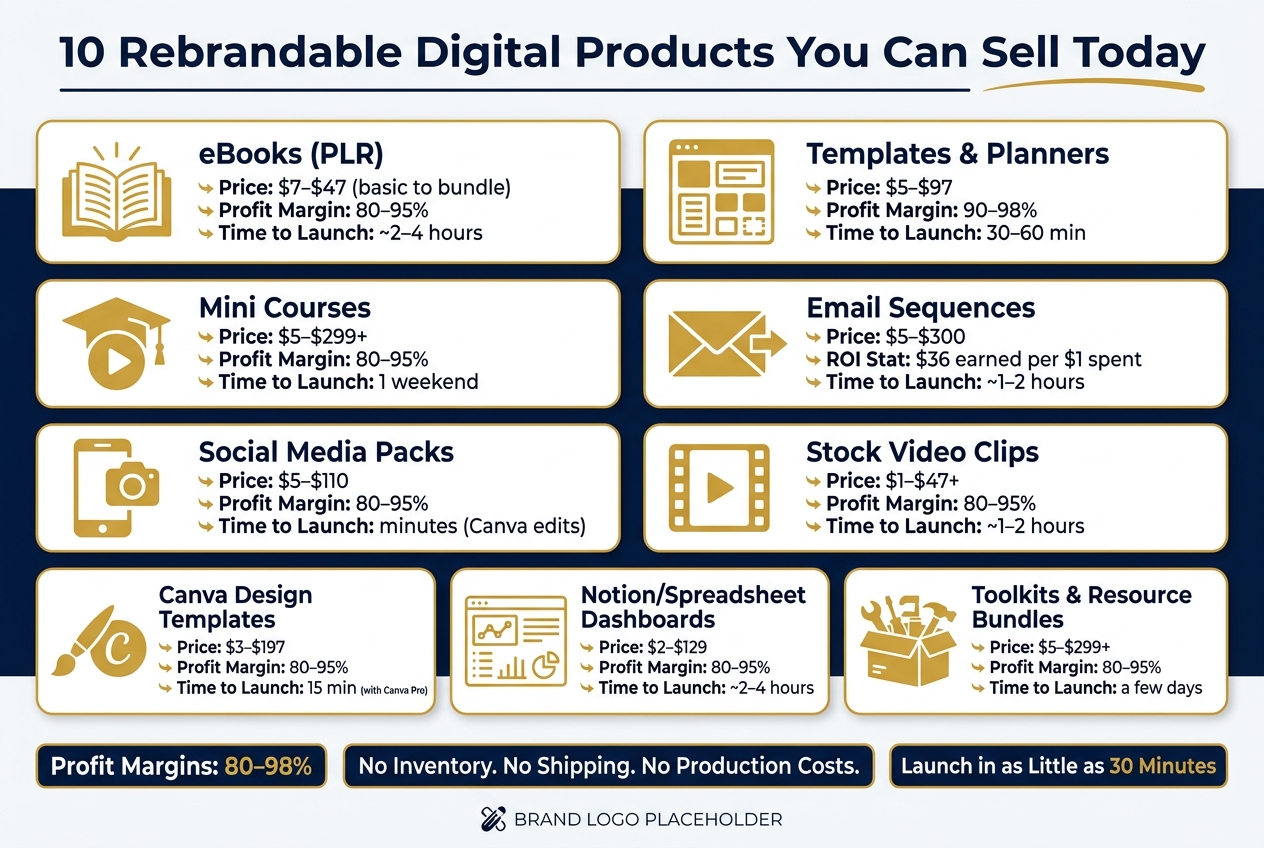
10 Rebrandable Digital Products: Profit Margins, Pricing & Time to Launch
Edit & Rebrand PLR eBooks with AI + Google Docs (Prompts Included!)
sbb-itb-e9b8513
1. Ebooks With Private Label Rights
PLR (Private Label Rights) ebooks are prewritten digital books that come with licenses allowing you to fully rebrand, edit, and resell them as your own. This includes creating custom covers, tweaking the content, and keeping 100% of the profits from sales. Thanks to their simplicity and perceived credibility, PLR ebooks consistently top the charts as the most popular PLR product category.
However, the secret to making these ebooks successful lies in not selling them in their original form. Adding 20–50% of custom content - like updated statistics, niche-specific stories, or real-world examples - can significantly increase their value and appeal. For instance, instead of sticking with a generic title like "Instagram Marketing Guide", you could rename it to something more results-driven, such as "30-Day Instagram Growth System". You can also use tools like Canva to redesign the cover, adjusting fonts and colors to align with your brand, and then export the final version as a polished PDF.
To further increase the perceived value, consider bundling the ebook with extras like checklists or worksheets. This can transform a basic product priced at $7–$19 into a bundle worth $17–$47. If you want to go even further, you could repurpose the ebook into a short video series or an email-based mini course, which could fetch $47 or more.
Some niches never go out of style. Topics like self-improvement, personal finance, health and wellness, and digital marketing continue to attract buyers. Platforms such as myAtlasLab make sourcing easy by offering a library of over 5,000 rebrandable ebooks across 50+ niches, complete with editable files ready for your customization.
Up next, we’ll explore how editable templates and planners can add even more variety to your digital product lineup.
2. Editable Templates and Planners
Editable templates and planners make it easy to turn sourced assets into ready-to-sell listings. By simply swapping out colors, fonts, and adding your logo, you can have a product ready in as little as 30–60 minutes. If you need to make more extensive changes, like rewriting or adding pages, expect it to take around 2–4 hours. Compare that to building a planner from scratch, which can take over 80 hours - a huge time saver!
For ease of use, tools like Canva offer a simple drag-and-drop interface, while platforms like Templett and Corjl provide advanced design options along with demo features. For example, a seller who transitioned from Canva to Templett for their wedding stationery saw an 85% reduction in customer support time. If you’re using Canva, preview your design in a free account to spot any hidden paywalls or Pro-only fonts before finalizing.
Specialized planners often outperform generic ones. Products like an "ADHD Focus Planner" or a "UGC Creator Portfolio Template" cater to specific audiences and their unique needs. Plus, a single base template can easily be adapted into multiple products. For instance, a budget planner could be rebranded as a "Student Budget Planner", "Family Budget Planner", or even a "Debt Payoff Tracker" with minimal effort.
Here’s a quick look at typical pricing strategies for planners:
| Product Type | Typical Price Range | Best For |
|---|---|---|
| Single Niche Planner | $5–$12 | Impulse buyers with specific needs |
| Comprehensive Planner Suite | $15–$35 | Professional or event use |
| Mega Bundles / Systems | $45–$97 | Business owners or "business in a box" buyers |
To improve conversions, try using an anchor pricing strategy. For instance, you could list your product at $50 and then offer it at a 50% discount, making $25 feel like a bargain. Adding bonuses like checklists, worksheets, or short video walkthroughs can also help your product stand out from plain PDF offerings.
Finally, platforms like myAtlasLab provide an extensive library of templates across more than 50 niches. This gives you access to rebrandable planners and content assets, making it easier to test different niches without starting from scratch.
Up next, we’ll dive into how online mini courses and workshops can open up even more rebranding opportunities.
3. Online Mini Courses and Workshops
Mini courses are one of the quickest digital products to launch. With a bit of effort, you can transform raw PLR (Private Label Rights) material into a live, ready-to-sell course in just a weekend. This makes them a fantastic option for quickly building credibility in your niche.
The secret to making a rebranded course feel like your product lies in the details. For instance, instead of offering a generic "Social Media Marketing" course, give it a title with a specific promise - like "30-Day Client Magnet System for Freelance Designers". Then, tweak the introduction and conclusion to match your brand's voice, and swap out generic examples for ones tailored to your audience. Stick to the 80/20 rule: keep 80% of the content as-is, and update 20% to reflect your niche, language, and unique framing.
"PLR courses work best when you treat them as raw material you improve, not as a finished product you spam everywhere." - EasyElementor
Want to boost the course's value without spending tons of extra time? Add simple extras like checklists, email templates, or even a Notion file. These small additions can make the course feel more polished and justify a higher price point. Even something as basic as a one-page "Start Here" PDF can improve the buyer's experience and reduce refund requests.
Here’s a snapshot of typical pricing for rebranded mini courses:
| Tier | Product Type | Price Range |
|---|---|---|
| Entry-Level | Micro-course or focused guide | $5–$47 |
| Standard | Core course with workbook | $19–$79 |
| Premium | Bundle or done-for-you system | $79–$299+ |
Before moving forward, make sure you understand the licensing terms. PLR material allows full rebranding, while MRR (Master Resell Rights) and RR (Resell Rights) often come with limitations.
4. Prewritten Email Sequences and Funnels
Email marketing is a powerhouse for ROI - Kajabi notes that marketers earn $36 for every $1 spent on email campaigns. With such potential, customizing email sequences can be a game-changer for driving engagement and boosting revenue. By tailoring these sequences to match your brand's voice, you can create a scalable strategy that resonates with your audience.
Start by using a PLR (Private Label Rights) or MRR (Master Resell Rights) email pack. These prewritten templates can be personalized with placeholders like {{first_name}}, {{brand}}, or {{niche}}, making them ready for immediate use. Adjust the tone and language to align with your audience - real estate agents might need a more professional tone, while fitness coaches could benefit from a casual, energetic style.
To make your email packs even more effective, consider adding extras like:
- Subject line variations to improve open rates.
- A/B testing tips for optimizing performance.
- A PDF setup guide for quick reference.
- A Loom walkthrough showing how to import emails into platforms like Mailchimp or ConvertKit.
Here’s a quick look at common email sequence types and their goals:
| Sequence Type | Typical Length | Primary Goal |
|---|---|---|
| Welcome / Nurture | 3–5 emails | Build trust with new subscribers |
| Product Launch | 6 emails | Create urgency and drive sales |
| Abandoned Cart | 3 emails | Recover lost sales with discount offers |
| Re-Engagement | 4 emails | Reconnect with inactive subscribers |
| Post-Purchase Upsell | 4 emails | Boost customer lifetime value |
When it comes to pricing, individual templates usually sell for $5–$25, while multi-email bundles range from $30–$100. For niche-specific packages targeting industries like real estate or consulting, prices can go as high as $100–$300. These options allow you to cater to various audiences while maximizing profitability.
5. Social Media Content Packs
Social media content packs are a go-to option for quick customization and immediate use. These rebrandable digital products are some of the fastest to personalize. Most packs are designed as Canva or Photoshop templates, making it easy to tweak colors, fonts, and logos in just minutes. Canva's "Apply to all pages" feature, for example, simplifies the process even further. While generic packs are more affordable, niche-specific packs for industries like real estate, beauty, or fitness can sell for $30–$80 or more. This adaptability is a game-changer for busy social media managers.
Social media managers often spend over six hours a day creating content. As content writer Fatma Al-hajri aptly notes:
"Businesses don't lack content… they lack words. Captions take time, energy, and creativity. Most business owners don't have any of that."
To successfully rebrand these packs, focus on three key areas:
- Visuals: Refresh designs to align with current trends. Pinterest Trends and Etsy bestsellers are great resources for inspiration.
- Captions: Personalize text to reflect the brand's voice and style.
- Call-to-Actions: Ensure each template includes clear instructions, like "DM for details" or "Click the link in bio." Also, confirm that graphics are formatted correctly for the intended platform (e.g., Instagram's size specifications).
A great example of this approach in action occurred in February 2024. A creator transformed a "Viral Quotes PLR Pack" into a 365-day motivational quote calendar. Priced at $27 on WarriorPlus, the product sold 83 copies in just 10 days, generating $2,241 in revenue. This product succeeded because it addressed a specific need for a targeted audience.
If you want to stand out even more, consider adding extra value to your packs. For instance, include a short tutorial video that walks buyers through editing the templates. This not only reduces refund requests but also makes the product feel more complete. If you're new to this, offering your first pack at a discount in exchange for testimonials can help build credibility.
| Pack Type | Typical Price Range |
|---|---|
| Small caption pack (20–30 captions) | $5 – $10 |
| Medium template pack (100+ designs) | $15 – $40 |
| Niche-specific pack | $30 – $80 |
| Large themed bundle (3,500+ templates) | $27 – $110 |
| Monthly template club/subscription | $10 – $25/mo |
6. Stock Video Clips and B-Roll Bundles
Adding multimedia elements like stock video clips and B-roll bundles to your rebrandable content lineup can make your digital offerings more versatile. These are pre-made video assets - think nature shots, office scenes, or lifestyle footage - that creators can use to enhance their content without needing to film anything themselves. With Private Label Rights (PLR), you can customize these clips by adding text overlays, swapping out background music, or including a branded intro. Tools like Canva, CapCut, and DaVinci Resolve make this rebranding process quick and straightforward.
To increase the appeal of your offerings, organize these clips into themed bundles tailored to specific niches. For example, a pack focusing on "remote work lifestyle" or "luxury finance" will resonate more with buyers than a random collection of footage. Consider including a short guide or usage license to clarify how the clips can be used. As Imago Cloud aptly puts it:
"Don't sell 'templates.' Sell a faster path to publish-ready assets."
The demand for these types of assets has surged, especially with the rise of faceless content creators, a trend that has gained significant traction in 2026. These creators rely on high-quality visuals to produce engaging content without needing to appear on camera. Popular categories include motivational clips, luxury aesthetics, business and finance visuals, AI/automation themes, health and wellness, and travel footage.
| Niche | Common Visuals | Demand Level |
|---|---|---|
| Luxury & Wealth | Private jets, supercars, penthouses | High |
| Health & Fitness | Gym workouts, yoga, meal prep | Consistently High |
| Tech & Productivity | Coding screens, minimalist desks | Growing |
| Travel & Aesthetic | Beaches, city skylines, "golden hour" | High |
| Business & Finance | Trading screens, charts, corporate meetings | Steady |
When pricing your bundles, many beginners start with $1 packs on platforms like Gumroad to build trust and attract initial buyers. For more premium, niche-specific bundles, prices typically range from $10 to $47 or more. If you have access to an extensive library of 4K clips with commercial rights - such as the 100,000+ HD and 4K clips spanning 50+ niches available through myAtlasLab - you can bypass the sourcing process and dive straight into packaging and selling.
7. Canva and Design Templates
Canva templates are an easy way to create rebrandable digital products. Buyers receive their own shareable copy via a template link, meaning your original file stays untouched. This makes the process about customization, not starting from scratch. With Canva Pro, you can have a rebranded product ready in as little as 15 minutes.
The secret to success? Focus on a niche. A generic "Social Media Kit" might get lost in the crowd, but something like a "Real Estate Agent Instagram Pack" can stand out and even sell for 2–3 times more. Ayush Agarwal, Co-founder & CPTO at Dodo Payments, explains it best:
"The template sellers making consistent revenue are not trying to serve everyone. They pick a specific niche - real estate agents, fitness coaches, wedding planners - and create template packs tailored to that audience. Specificity sells."
This targeted approach also makes rebranding much simpler.
Rebranding itself is incredibly efficient with Canva. Use the "Apply to all pages" option in the color palette tab to adjust the entire template's look instantly. The "Find and Replace" feature lets you update old product names across multi-page documents in seconds. To align the template with your brand, swap out the cover design and update around 30–50% of the text. Popular visual trends like Poetcore, Dark Coquette, and Dark Academia are particularly appealing in 2026, so matching your design’s palette and typography to these styles can give your templates an edge.
Once rebranded, you can increase perceived value by turning a single template into a bundle. Add extras like a quick guide, checklist, or short video walkthrough. Lori Ballen, a digital marketer, puts it this way:
"You don't need 50 new designs. You need one design done five ways - and a system that multiplies it."
This approach helps differentiate your product and justify higher pricing.
Speaking of pricing, the market has clear tiers. Single templates typically sell for $3–$17, while bundles of 50+ designs can go for $47–$97. Premium brand kits can command $97–$197. Interestingly, templates priced between $30–$49 convert 28% better than cheaper options under $10, as buyers associate higher prices with professional quality. If you're looking for a head start, platforms like myAtlasLab offer ready-to-use templates for lead magnets and content calendars with full commercial rights. This lets you skip the blank canvas and dive straight into customization.
8. Printables for Home, School, and Business
Printables are a simple, cost-effective way to break into digital product sales. They fit perfectly with strategies focused on quick customization and high profit margins. Once you've updated the file, there’s no need to worry about shipping, inventory, or production costs per sale. With profit margins typically ranging from 90% to 98%, they rank among the most profitable digital products you can sell.
The key to success? Find your niche. A generic daily planner might get lost in a sea of similar products, but something like a "Freelancer Finance Tracker" or a "Teacher Morning Routine Collection" can target a specific audience and meet their unique needs. For instance, Rachel Morrison, an elementary school teacher from Texas, started rebranding basic educational worksheets using Canva in March 2025. By January 2026, she had created 87 digital products. Her standout item, a multiplication worksheet set priced at $6.50, sold over 3,200 copies, earning her a steady $4,500 monthly passive income within nine months.
Another major advantage of printables is how quickly you can launch them. With pre-made PLR (Private Label Rights) files, it’s possible to turn a raw file into a polished product in just 30 to 60 minutes.
Rebranding effectively is more than just slapping on a new logo. It often involves updating 30–50% of the content, refreshing the design, and adding niche-specific extras like bonus pages or even a short video guide. A pro tip: if you’re using Canva, open the final design in a free Canva account before publishing. This ensures your customers won’t run into issues with Pro-only fonts or elements that require payment.
Pricing for printables varies based on their type and complexity.
- Basic items like art prints or recipe cards generally sell for $3–$15.
- Business templates - invoices, media kits, contracts - are priced between $15 and $75.
- Premium bundles or toolkits can command $45–$200+.
One way to boost sales without creating new products is bundling. For example, packaging a "New Client Welcome Pack" with an intake form, invoice template, and onboarding checklist can increase the average order value significantly.
Next, let’s dive into how Notion, Spreadsheet, and System Dashboards can expand your digital product offerings even further.
9. Notion, Spreadsheet, and System Dashboards
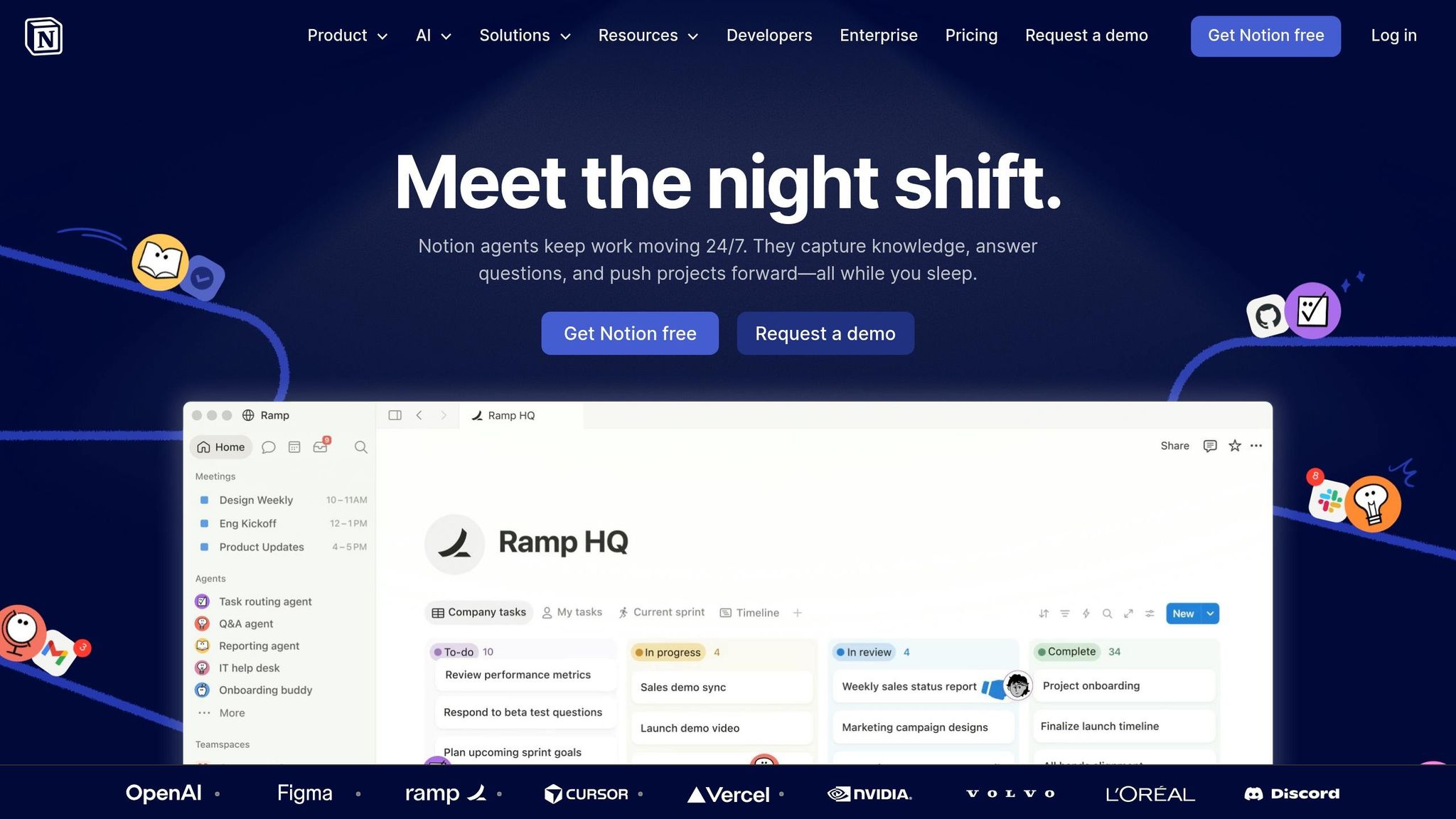
Notion, spreadsheets, and system dashboards are some of the most in-demand digital products to rebrand and sell. With Notion alone boasting over 100 million users, there's a massive appetite for pre-built productivity systems. People are willing to pay for tools that save them hours of setup time.
These days, buyers tend to favor comprehensive, all-in-one systems over basic, single-purpose templates. For instance, a "Freelancer OS" that combines a CRM, invoicing tool, and project manager into one central hub can be sold as a one-time purchase instead of a recurring $20/month SaaS subscription. This bundled approach often allows for a higher price tag.
Rebranding doesn’t have to mean starting from scratch. Small but strategic changes can make a big difference. Swap out generic titles for more specific, benefit-driven ones - something like "Notion Client Onboarding Dashboard for Freelance Designers" will resonate far more than a vague title like "Business Planner". Then, update details like the color scheme, fonts, and placeholder text to reflect your brand's style. To make your product even more user-friendly, add a "Start Here" page or include a quick Loom video walkthrough.
"You're not selling a digital file. You're selling saved time, proven systems, and the confidence that comes from using something a more experienced person has already figured out." - Dani, GM of SendOwl
Pricing these dashboards depends on their complexity. Simple tools like habit trackers or goal planners usually sell for $2–$15. On the other hand, a full-featured operating system with interconnected databases and detailed documentation can fetch anywhere from $39 to $129. To refine your product idea, check out existing listings on platforms like Etsy or the Notion Marketplace. Pay close attention to one-star reviews - they often highlight gaps or frustrations that you can address in your version.
From here, consider expanding into toolkits or resource bundles to broaden your product lineup.
10. Toolkits and Resource Bundles
Expanding your rebrandable offerings with toolkits and resource bundles is a smart way to grow your product lineup. These types of digital products are some of the quickest to develop and launch. Why? Because they’re built using existing PLR (Private Label Rights) assets - things like templates, checklists, trackers, and guides. Instead of starting from scratch, you’re curating, rebranding, and packaging. With a focused effort, you can transform raw PLR materials into a ready-to-sell product in just a few days.
The trick to making these bundles successful lies in specific positioning. A generic name like "Business Starter Pack" may not grab attention. But something like "Client Proposal Kit - Freelancer Edition" or "30-Day Instagram Growth Bundle for Local Real Estate Agents" immediately resonates with a specific audience. As Curtis Blackmore from Business Insights & Ideas explains:
"Narrow beats broad because buyers trust relevance."
To create a bundle that stands out, apply the 80/20 rule: keep 80% of the original content, but tweak 20% to align with your niche. This could mean updating the introduction, swapping out generic statistics for industry-specific ones, or renaming the product using the formula [Outcome] + [Audience] + [Format]. Always include a one-page "Start Here" PDF to guide users. These small but targeted changes make your product more relevant and appealing to your market.
When it comes to pricing, there’s a clear structure to follow:
- Mini-toolkits and sample packs: $5–$19
- Standard bundles: $19–$79
- Comprehensive resource vaults: $79–$299+
Platforms like myAtlasLab offer access to over 5,000 rebrandable ebooks, templates, and guides with full commercial rights. This means you won’t have to spend time hunting down individual PLR sources - you’ll have a wealth of materials ready to work with.
Before diving into rebranding, make sure the product checks a few key boxes: it should solve a real problem, generate search interest, and align with what buyers are willing to pay. By tailoring your bundles to meet specific needs, you’ll be able to quickly launch products that genuinely resonate with your audience.
Conclusion
Rebranding digital products provides a quick and cost-efficient way to launch without investing over 80 hours or spending more than $1,000 on development. Using pre-made PLR (Private Label Rights) assets, you could have a product ready to go in as little as 30 minutes.
The potential for profit is undeniable. With no inventory to manage, no shipping, and no production costs, digital products often deliver profit margins ranging from 80% to 100%. Plus, since a single product can be sold endlessly, scaling is all about smart positioning and consistent marketing. These high margins highlight the value of the digital product types we've explored.
The ten product categories covered here - ranging from ebooks and email sequences to Notion dashboards and resource bundles - are all ready for immediate sale. But here’s the secret: success lies in adding your personal touch. Update the design, tweak the title, and tailor the product to a specific audience. These small adjustments not only set your brand apart but also boost the product's appeal in the marketplace. That’s the difference between a product that sells and one that gathers dust.
"The winners aren't necessarily the people creating the most content - they're the ones packaging, positioning, and distributing solutions the fastest." - Resell Ready
To take advantage of these opportunities, myAtlasLab offers access to over 5,000 rebrandable ebooks, templates, and guides - all with full commercial rights. Their platform includes a 10-phase Launch OS and AI tools designed to help you build, brand, and market your products effortlessly. Choose between the Library Lifetime plan for $97 or the Pro Lifetime plan for $147, and gain access to a library of assets perfectly suited for this business model. Why wait? Start leveraging these tools today!
FAQs
How do I know a PLR license lets me rebrand and sell?
Always take the time to carefully review the specific PLR license agreement that comes with the product. While most PLR agreements allow you to edit and resell the content, the exact terms can differ. For instance, some licenses might restrict how much you can modify, limit which platforms you can sell on, or even prohibit reselling rights entirely. Don’t make assumptions - double-check the terms to ensure your intended use aligns with the license before you start rebranding or selling the product.
What changes should I make so my rebranded product is unique?
To give your rebranded product a fresh identity, don't just stop at swapping out covers or logos. Dive deeper by rewriting 30–50% of the content so it aligns with your brand's tone and speaks directly to your audience. Upgrade the visuals too - replace generic stock images with original designs or royalty-free graphics that enhance the product's appeal.
Want to take it a step further? Add extras like helpful checklists, step-by-step instructions, or guides that provide real value. For a bold transformation, think about switching up the format entirely. For instance, you could turn an eBook into a video course, an interactive dashboard, or another dynamic medium that better suits your audience's preferences.
Where should I sell rebranded digital products online?
You can sell rebranded digital products on well-known platforms such as Etsy, Gumroad, Shopify, Sellfy, Lemonsqueezy, and Whop. These platforms make it easy to upload your files, set your prices, and automate the delivery process. However, before listing your products, carefully review the licensing terms of your digital assets. This ensures that your chosen platform aligns with the resell rights granted for the products you're offering.