Ultimate Guide to Monetizing Digital Assets Online
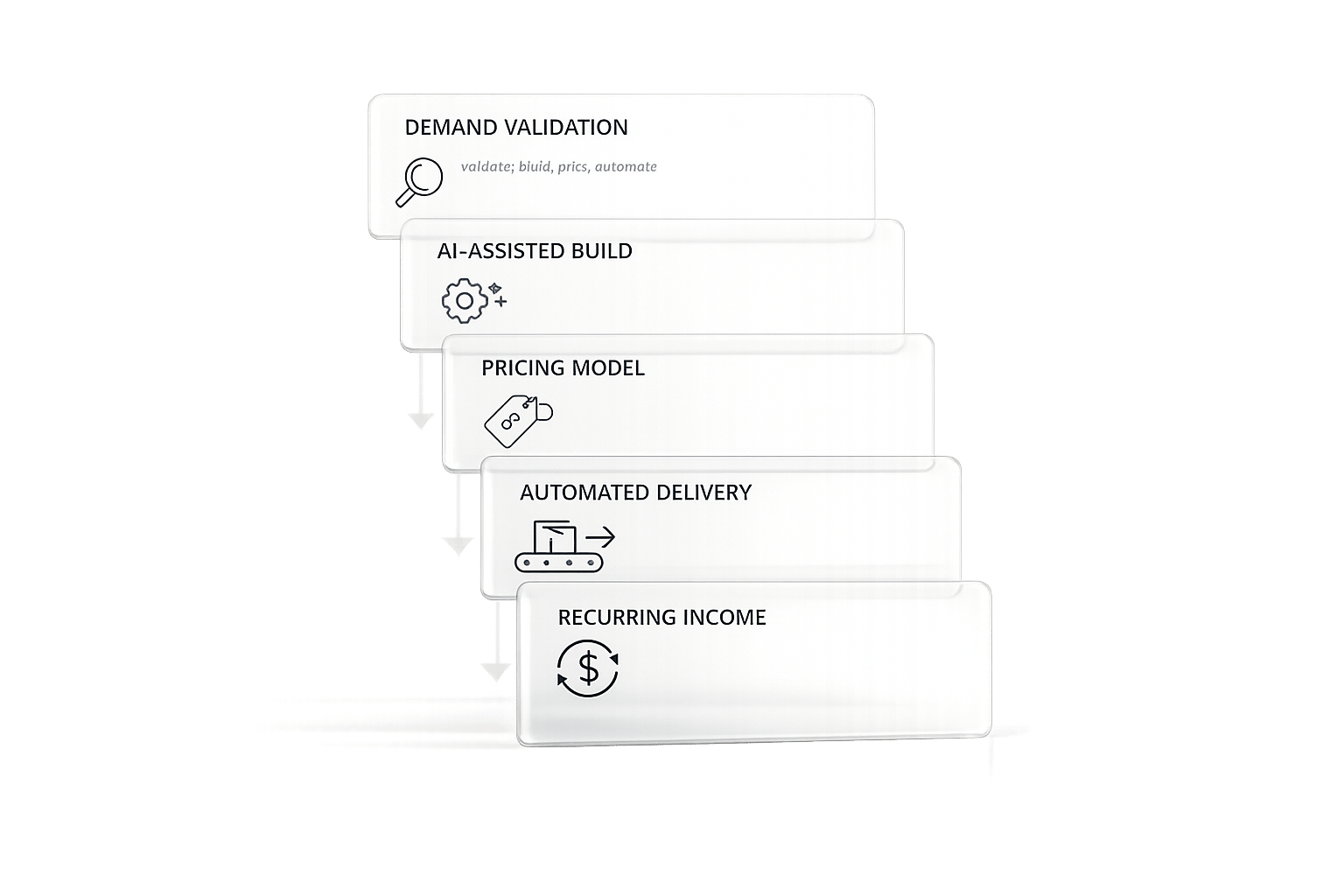
Validate demand, build AI-assisted digital products, pick pricing models, and automate delivery to earn recurring income.
Ultimate Guide to Monetizing Digital Assets Online
Want to earn money from digital products? Here's how:
- Digital assets like e-books, templates, and online courses are low-cost to create and can be sold repeatedly for profit.
- The global digital economy is worth trillions, with the U.S. leading in markets like e-books ($15B) and corporate eLearning ($44.6B by 2028).
- Success starts with validating demand - look for real buyer interest through Reddit, Amazon reviews, or pre-order tests.
- Tools like myAtlasLab simplify creation with ready-to-use assets and AI-powered tools for branding and marketing.
- Profitable pricing models include one-time sales, bundles, or subscription plans for recurring income.
Key takeaway: Focus on solving specific problems, automate delivery, and use AI to speed up production and marketing. With the right strategy, creators can reach $1,000/month in under 90 days.
The 10 BEST Digital Products to Sell Online Right Now 💰
sbb-itb-e9b8513
Identifying and Planning Profitable Digital Assets
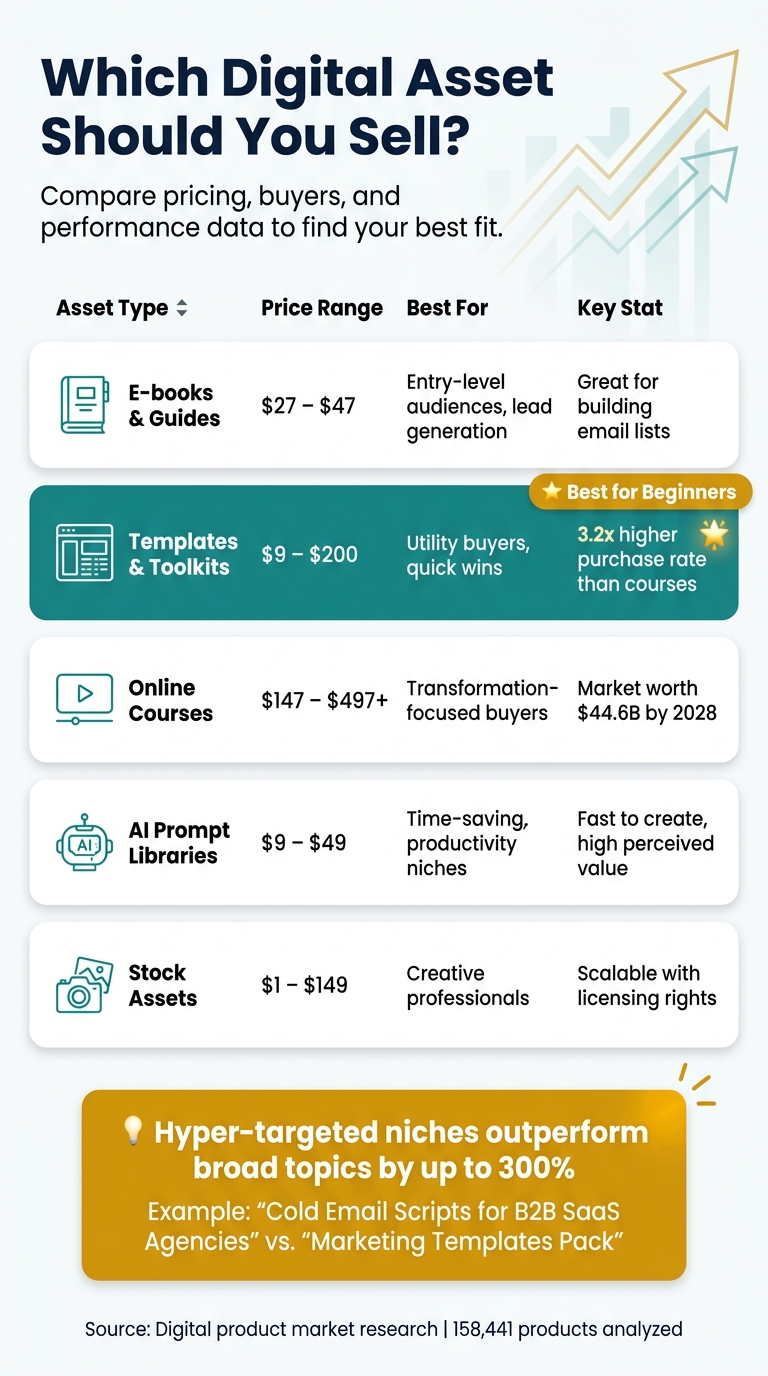
Digital Asset Types: Pricing, Audience & Profit Potential Compared
How to Identify Market Demand
One common thread among failed digital products is skipping a crucial step: confirming demand. A study of 158,441 digital products revealed that 44.6% made no money at all - often because creators didn’t verify if people actually wanted what they were offering. Real demand isn’t about what people say they want; it’s about what they do. Actions like saving a post, searching for a solution, or leaving a frustrated review are far more telling than a casual “that sounds cool” from a friend.
So, how do you spot genuine demand? Start by diving into Reddit. Look for threads where the same questions keep popping up - repeated inquiries signal unmet needs. For a quicker analysis, add .json to the end of a Reddit thread URL and feed the raw data into an AI tool to uncover pain points and common language. Another goldmine? 3-star reviews on Amazon, Etsy, or Udemy. These reviews often say, “It was good, but…” and highlight exactly what’s missing in the market.
"The market doesn't reward the best product. It rewards the best-understood market." - Angelina Mihaylov, Founder, Digital Mastery Depot
When checking search data, focus on keywords that include terms like "buy", "template", "download", or "PDF." These phrases show intent to purchase, not just casual browsing.
Once you’ve identified clear demand, the next step is selecting a product format that aligns with your expertise.
Choosing the Right Digital Asset Type
Your expertise should guide the format of your digital product. Start by asking yourself: What problems have I solved? What knowledge or tools can save others time or money? The answer will help you determine the best type of product to create.
From there, it often comes down to choosing between two strategies: a volume approach (lower price, broader audience) or a value approach (higher price, deeper impact). For first-time creators, templates and toolkits are a strong option. These products currently boast a 3.2x higher purchase rate than online courses.
Here’s a quick breakdown of popular digital asset types:
| Digital Asset Type | Typical USD Price Range | Best For |
|---|---|---|
| E-books & Guides | $27 – $47 | Entry-level audiences, lead generation |
| Templates & Toolkits | $9 – $200 | Utility buyers, quick wins |
| Online Courses | $147 – $497+ | Transformation-focused buyers |
| AI Prompt Libraries | $9 – $49 | Time-saving, productivity niches |
| Stock Assets | $1 – $149 | Creative professionals |
One rule applies across all formats: specificity sells. A product like "Cold Email Scripts for B2B SaaS Agencies" will almost always outperform something generic like "Marketing Templates Pack." Hyper-targeted niches can perform up to 300% better than broad topics.
How to Validate Your Digital Product Idea
Before diving in, make sure people are willing to pay for your idea. Validation is key.
The simplest way? Direct outreach. Contact 10 potential buyers via LinkedIn or email, describe your product in one sentence, and ask if they’d pay a specific price. For a broader test, create a landing page with a “Pre-order” or “Buy” button that redirects to a waitlist. A conversion rate above 10% is a green light; anything below 5% means you may need to rethink your offer.
"The only signal that matters is money changing hands - or at minimum, a firm commitment to pay at a specific price." - Alex Berman, Founder, ScraperCity
Tools like myAtlasLab’s AI platform can speed up this process by helping you identify buyer personas, assess competitor gaps, and project revenue scenarios. Creators who validate their ideas effectively often reach the $1,000/month milestone in under 90 days, compared to the 11-month average for those who skip this step.
Monetization Models for Digital Assets
Once you've validated your idea and chosen the type of digital asset to create, the next step is deciding on a pricing model. This choice is critical - it impacts your cash flow, workload, and long-term revenue potential.
One-Time Purchases and Bundled Offers
A one-time purchase model is straightforward: set a price and start selling. This works best for static products like templates, ebooks, or stock assets. However, since revenue relies entirely on new customers, sales can plateau over time.
Bundling products is a smart way to increase revenue. For example, instead of selling a single template for $27, you could combine three or four related products into a bundle priced at $97. This approach raises your average order value (AOV) without requiring extra traffic. Adding an order bump at checkout can further boost AOV by 15–30%.
Another strategy is to create a price ladder with three tiers: entry-level, core, and premium offers. This structure allows you to cater to buyers with varying budgets and maximize customer lifetime value.
| Tier | Price Range | Example |
|---|---|---|
| Entry-Level | $10 – $50 | Single template, short guide |
| Core Offer | $100 – $300 | Template bundle, mini-course |
| Premium | $500+ | Full course, done-for-you kit |
Once you've optimized your one-time sales, consider recurring revenue models for more predictable income.
Subscription and Membership Models
Subscriptions are an excellent way to generate consistent, recurring revenue. However, to succeed with this model, you need to consistently deliver value - whether it's through regular updates, community interaction, or improving your assets. Without ongoing value, customer churn can quickly become an issue.
"Recurring revenue is the holy grail of digital product businesses." - Joanna Taylor, Author, Kourses
One effective strategy is to pair a low-cost product with a recurring membership. For instance, a $47 template pack could lead to a $19/month membership that offers updates, new assets, and access to a private forum. Products with community access are often priced 40% higher than standalone downloads. Offering multiple membership tiers - Basic, Standard, and Premium - can further enhance perceived value and appeal to a broader audience.
Here's an example of how this approach works in practice: Maria, a marketing consultant, built a $15,505/month revenue system by combining several products. She sold $29 Canva templates (300 sales/month), a $197 email course (15 sales/month), and a $47/month marketing kit with 50 active subscribers.
Finally, explore licensing and white-label opportunities to diversify your income streams.
Licensing and White-Label Opportunities
Licensing provides another revenue avenue by allowing others to use, modify, or resell your product. Instead of selling the finished product directly, you sell usage rights. Licensing tiers typically include personal use, commercial rights, and white-label or resale rights. Each tier is priced higher based on the value it offers to buyers.
For example, myAtlasLab offers a library of over 5,000 rebrandable ebooks, templates, and guides with full commercial rights. These assets are ideal for creators who want to build a product line quickly without starting from scratch.
"Price for value, not effort." - Nevuto Team
Whether you choose direct sales, subscriptions, or licensing, each model offers unique benefits and challenges. The key is aligning your pricing strategy with your goals and audience.
Using Technology to Create and Scale Digital Assets
Not long ago, creating a digital product was a time-intensive process that required weeks of effort across research, writing, and design. Today, AI has transformed this landscape, shrinking development timelines dramatically. Now, creators can take an idea and turn it into a market-ready product in record time - often without needing a large team or advanced technical skills. This evolution has made it easier than ever to use AI throughout every stage of digital asset development.
AI Tools for Faster Product Creation
AI tools have revolutionized how quickly digital products can be created. What starts as a vague concept can be turned into a structured e-book outline, complete with pricing ideas and sales strategies, in as little as 15 minutes. Tools like ChatGPT and Jasper AI can then generate full chapters with just a few simple prompts. This rapid production process opens the door to a variety of monetization strategies by cutting down the time it takes to bring a product to market.
"AI tools have now removed the last major barrier that held most people back: the need for expertise or content creation skills." - Adegbenga Adefemi, Online Marketer
Platforms like myAtlasLab take this efficiency to another level. They offer a library of over 5,000 rebrandable e-books, templates, and guides, paired with AI tools to help users generate product ideas, branding assets, and SEO-friendly content. Instead of starting from scratch, creators can customize professionally designed assets and launch their products faster. myAtlasLab’s 10-phase Launch OS provides a step-by-step guide, covering everything from selecting a product to setting up sales.
Using AI for Branding and Marketing
Once your product is ready, AI simplifies much of the marketing process. It can write sales copy, create social media kits, and design e-book covers or other visuals - even if you lack design experience. While AI handles the heavy lifting, refining its results with human expertise ensures the final product resonates with your audience.
One effective strategy is using AI to analyze customer language from forums and social media. By incorporating the exact phrases your audience uses into your sales copy, you can craft messaging that directly addresses their needs and desires. This approach helps create benefit-driven content that connects with potential buyers.
AI's impact doesn’t stop at creation and marketing - it also plays a critical role in growing your product line.
Using AI Data to Grow Your Product Line
After launching your first digital asset, AI can help you expand your portfolio quickly. Sellers with three or more products earn an average of $5,201 per month - 5.7 times more than those relying on a single product. What used to take 18 months to build a multi-product portfolio can now be achieved in just 3–6 months with AI.
AI excels at data-driven development. By analyzing competitor reviews and forum discussions, it identifies common pain points that can inspire new product ideas. It also helps optimize pricing strategies - such as using tiers between $30 and $49 - and implementing multi-tiered offerings, which can double revenue potential. Even small improvements, like increasing your conversion rate from 2% to 3%, often have a greater impact on revenue than simply doubling your website traffic.
"The businesses that win in the next decade won't be the ones working the hardest; they will be the ones navigating the smartest." - Alex, Author, Expert AI Prompts
Delivery, Legal, and Performance Basics
Once you've planned and defined your digital asset, the next step is to establish a solid framework for delivery, legal compliance, and performance tracking. These elements are critical for scaling your business effectively.
Setting Up a Reliable Delivery System
Creating a great digital product is just the beginning. If you can't deliver it seamlessly, customers will leave. In fact, platforms that fail to provide instant access see 40% higher cart abandonment rates. To avoid this, your delivery system should be fully automated.
Here’s what works:
- Immediate Access: Offer instant downloads on the confirmation page and through an automated email. This reduces support issues and improves customer satisfaction.
- Secure Links: Use time-limited, count-restricted download links to minimize unauthorized sharing.
- PDF Stamping: For high-value content like templates or guides, embed the buyer's email address into the file to discourage piracy.
One small but important detail is file format. Customers prefer a "digital locker" experience where they can download individual files instead of dealing with bulky .zip archives. Be clear on your product page about any software requirements (e.g., "Requires a Notion account") and define your support boundaries to manage expectations and reduce friction.
"The difference between a creator who makes $200 a month and one who makes $20,000 isn't usually the product. It's the platform, the pricing, and the checkout." - Joanna Taylor, Kourses
Additionally, set clear policies on updates. Whether you offer lifetime updates, a set timeframe (like 12 months), or none at all, customers who know what to expect are less likely to complain.
Legal and Tax Basics for U.S. Creators
If you're a U.S.-based creator selling digital products, you’ll need to navigate a three-layer tax system: federal income tax, self-employment tax, and state sales tax. Because digital products have virtually no Cost of Goods Sold (COGS), nearly all revenue is taxable profit. Here’s a quick breakdown:
- Self-Employment Tax: A flat 15.3% on net profits for Social Security and Medicare.
- State Sales Tax: The Wayfair Supreme Court decision means you may owe sales tax in states where you’ve never been if you exceed $100,000 in revenue or 200 transactions in that state. The taxability often depends on the product type - pre-recorded courses are usually taxable, but live interactive sessions might not be.
To simplify sales tax compliance, consider using a Merchant of Record (MoR) platform. These platforms handle tax calculations, collections, and remittance for you but charge a higher per-sale fee (typically 5–10%).
For income reporting, federal 1099-K thresholds currently require reporting at $20,000 in gross payments and more than 200 transactions. However, some states, like Massachusetts and Vermont, have much lower thresholds - just $600 with no transaction minimum. To stay safe, reserve 25–30% of your revenue for quarterly tax payments. If your annual net profit exceeds $60,000–$80,000, consult a CPA about electing S-Corp status to reduce your self-employment tax.
Finally, if you’re using rebrandable assets from myAtlasLab, make sure you hold commercial rights before reselling modified content. This ensures you’re legally allowed to sell the rebranded product as your own.
Tracking Results and Improving Your Products
A strong delivery system and legal compliance lay the groundwork for continuous improvement. The best digital products evolve over time; most successful versions aren’t the first - they’re the third or fourth iteration. Start by tracking these four key metrics every month: conversion rate, customer acquisition cost (CAC), refund rate, and return customer rate.
| Metric | Healthy Benchmark | What to Do If It's Off |
|---|---|---|
| Conversion Rate | 1%–3% | Revise your copy or pricing |
| Refund Rate | Below 5% | Improve product quality or clarify your claims |
| Return Customer Rate | 20%+ | Create more upsells |
| CAC | Under 30% of product price | Focus on organic channels or refine ad targeting |
If your conversion rate falls below 1%, don’t rush to drive more traffic. Instead, optimize your sales page and checkout process. For example, removing unnecessary fields or adding an order bump can increase your average order value (AOV) by 15–30% without additional ad spend. Abandoned cart emails are another easy fix, recovering 10–15% of lost sales.
Pricing strategies also play a big role. Switching from $100 to $97 can boost conversions thanks to "charm pricing". Over time, use your data to build a product ladder. For example:
- Free lead magnets feed into low-cost offers ($9–$49).
- Mid-tier products ($99–$499) lead to premium programs ($500+).
A well-structured ladder typically shows 10 to 20 low-tier sales for every one high-ticket purchase.
Conclusion: Start Monetizing Your Digital Assets Today
Turning digital products into a source of income doesn't have to be complicated. The process boils down to a few key steps: validate demand, create a solution that addresses a specific need, automate delivery, and guide your customers through a tiered product offering. By sticking to this approach, you can generate early revenue while laying the groundwork for long-term growth.
AI tools play a powerful role in this process, cutting production time by an impressive 60%–80%. This speed allows you to quickly test ideas and refine your products based on audience feedback - an essential advantage when you're just starting out.
"Specificity is the variable that separates the sellers earning $200 per month from the ones earning $2,000 per month." - Ali Raza, Freelancing Expert, Eblowee
The strategies outlined here - validation, creation, automation, and scaling with AI - are proven to help creators build a steady income stream. Tools like myAtlasLab simplify the journey by offering an extensive library of over 5,000 rebrandable ebooks, 100,000+ HD/4K video clips across 50+ niches, and a comprehensive 10-phase Launch OS. For a one-time fee of $147, their Pro Lifetime plan also includes advanced AI tools for generating product ideas, branding, and SEO, along with full commercial rights to all assets.
With the global digital products market expected to hit $950 billion by 2026, the potential for creating a sustainable income is enormous. Armed with the right tools and strategies, now is the perfect time to get started.
FAQs
How do I pick a digital product idea that will actually sell?
To pick a digital product idea that people will buy, zero in on market demand. The best products address clear, immediate problems that people are actively looking to solve.
Here’s how to validate your idea:
- Make sure it tackles a pressing issue.
- Be able to sum it up in a single, clear sentence.
- Look for proof of demand, like high search volume or strong competitor sales.
Starting with simple formats like templates or checklists can help you gain trust and build momentum quickly.
What’s the simplest way to validate demand before I build anything?
The simplest way to confirm demand is by watching what real customers do. Pay attention to actions like people actively searching for solutions, voicing frustrations about specific problems, or already spending money on similar products.
You can test demand in several ways:
- Explore niche communities to see what people are talking about or struggling with.
- Check search volumes to understand how often people look for related solutions.
- Create a landing page to measure interest and collect feedback.
The most convincing proof? Pre-selling. If someone is willing to invest time or money in your idea before it even exists, you've got solid evidence of demand.
Which pricing model should I start with: one-time, bundles, or subscription?
Creating a pricing structure with multiple tiers is a smart way to cater to different budgets while increasing your average order value. Start by offering at least two price points:
- A lower-priced option designed to attract new customers. This can serve as an entry point for those hesitant to invest heavily upfront.
- A higher-priced flagship product that delivers more value and generates significant revenue.
For even better results, consider a three-tier model like Starter, Standard, and Premium. This approach provides clear options for customers at various levels of commitment and spending capacity.
When deciding on payment structures, think about the nature of your product:
- One-time purchases work well for standalone assets or tools.
- Subscription models are ideal for content that evolves over time or requires ongoing access.
By structuring your pricing thoughtfully, you can appeal to a broader audience while encouraging customers to explore higher-value options.