PLR vs. Original Content: Which Is Better for Reselling?
Compare PLR and original content for reselling—cost, time, SEO risks, and when to use each for best results.
PLR vs. Original Content: Which Is Better for Reselling?
Both PLR (Private Label Rights) content and original content have their strengths and weaknesses, and your choice depends on your goals, budget, and timeline.
- PLR Content: Affordable, quick to launch, and flexible for repurposing, but often requires customization to stand out and avoid SEO penalties. Licensing terms can also limit usage.
- Original Content: Offers full ownership, better SEO performance, and builds trust, but is more expensive and time-consuming to create.
Quick Comparison
| Factor | PLR Content | Original Content |
|---|---|---|
| Cost | Low ($1–$50 per asset) | High ($600+ per asset) |
| Time to Market | Hours | Weeks to months |
| Customization Need | High | Low |
| SEO Impact | Risk of duplicate penalties | Strong for search rankings |
| Scalability | Easy to scale quickly | Slower, but builds authority |
If you're on a tight budget or need to test a niche fast, PLR is a good starting point. For long-term growth and brand credibility, investing in original content is often the better route. A mix of both can offer the best balance.
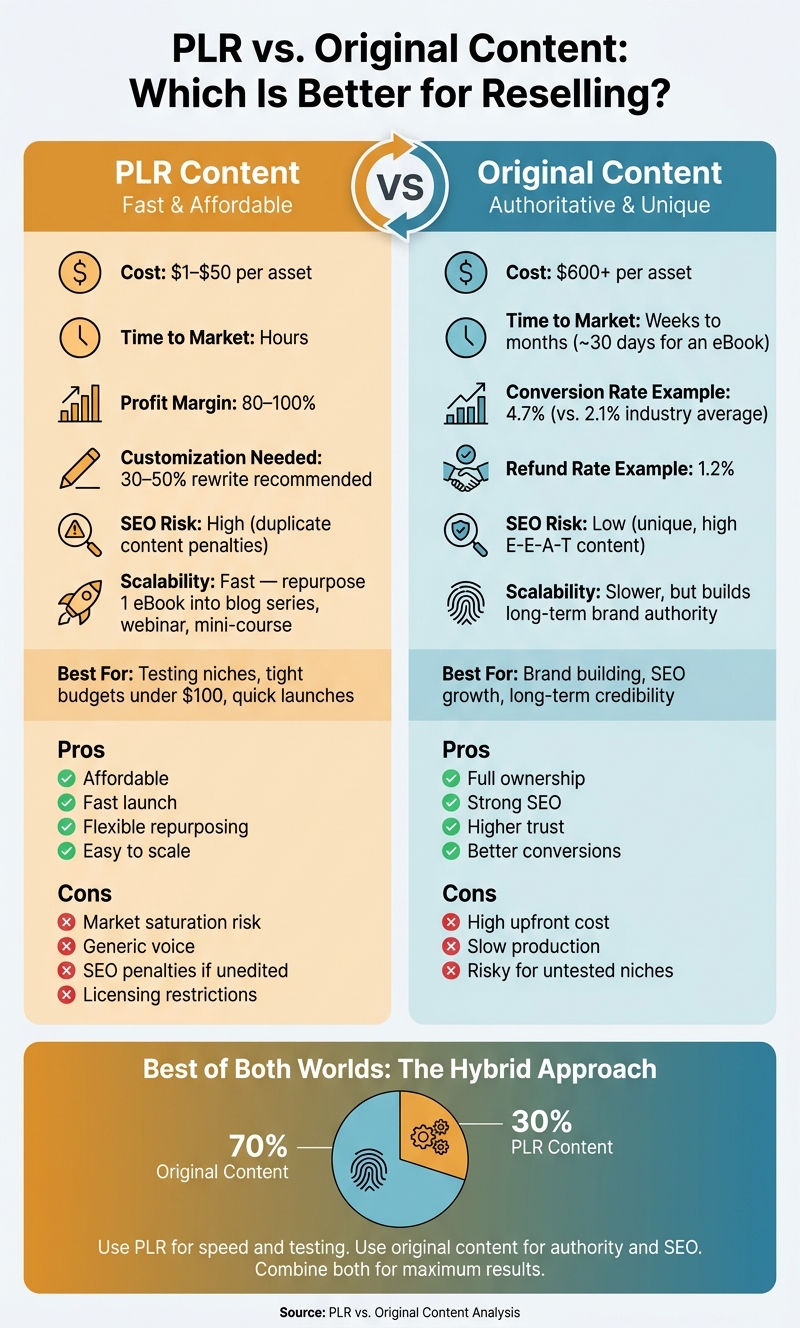
PLR vs. Original Content: Key Differences for Resellers
PLR Content: Benefits and Drawbacks
Advantages of PLR Content
One of the biggest perks of PLR (Private Label Rights) content is its affordability. For instance, article packs can cost as little as $1–$5, eBooks typically range between $10 and $50, and even full online course bundles rarely exceed $300. By comparison, creating original content - hiring writers, researchers, and designers - can run into hundreds or even thousands of dollars per asset. For small teams or solo entrepreneurs, that difference in cost can make a big impact.
Another advantage is speed. With PLR, you start with a pre-made framework, allowing you to focus on editing and rebranding. This means you can launch faster, test a niche, gather feedback, and make improvements - all before competitors working from scratch even finish their first draft. Plus, digital product resellers using PLR can enjoy profit margins of 80–100% since there are no royalties, manufacturing costs, or shipping fees to worry about.
PLR content is also incredibly flexible. A single asset can be repurposed in multiple ways. For example, a 10,000-word eBook could be broken down into a blog series, turned into a webinar script, or even formatted into a downloadable checklist.
Drawbacks and Risks of PLR Content
However, PLR’s low cost and quick turnaround come with some serious trade-offs. For starters, its accessibility can lead to market saturation. When multiple sellers offer the same product without making meaningful changes, the market can quickly become overcrowded. This often results in price wars and shrinking profit margins. To avoid this, it's a good idea to search major marketplaces for the PLR product title before buying to assess the competition.
Quality is another potential issue. While some PLR packs are well-written and thoroughly researched, others can feel generic or outdated. Selling low-quality PLR can hurt your brand’s reputation. Experts suggest rewriting 30–50% of the content to make it more unique and valuable.
There’s also a risk to your SEO efforts. Google penalizes duplicate content, so using PLR without significant editing could negatively affect your search rankings.
"Selling PLR without customization rarely produces strong results in today's competitive digital marketplace." - Resell Ready
Licensing is another key factor to consider. Each PLR product comes with specific terms that may limit how you can use it. For instance, some licenses prohibit free distribution, restrict bundling, or set minimum resale prices. Ignoring these terms isn’t just risky for your business - it could also land you in legal trouble. In the U.S., the FTC holds brand owners accountable for any false claims made in their content, even if they didn’t write it themselves. Always review the license details before making a purchase.
While PLR content offers clear advantages, these challenges underline the importance of balancing its benefits with careful planning and customization.
sbb-itb-e9b8513
PLR Doesn't Sell Until You Do This
Original Content: Benefits and Drawbacks
Resellers need to carefully consider both the advantages and challenges of creating original content when developing their strategy.
Advantages of Original Content
One of the biggest benefits of original content is complete ownership. You hold the copyright, set the licensing terms, and have full control over how your product is sold or distributed. This eliminates the risk of running into licensing issues.
Ownership also boosts the perceived value of your product. Buyers can recognize when something is crafted with genuine expertise. A great example is from 2026, when a consultant named Alexandra marketed her digital course using "Transparency Marketing." She openly shared that her course combined professionally researched frameworks with her 10 years of consulting experience. The result? A 4.7% conversion rate, more than double the industry average of 2.1%, and a refund rate of just 1.2%.
"Original content tends to be more engaging and trustworthy, so balancing both types while ensuring quality helps you create a compelling content strategy." - Cyber Media Creations Team
Original content also delivers a strong SEO advantage. Search engines reward fresh, unique material and penalize duplicate content, which is a common issue with unmodified PLR. By building your catalog around original assets, you can achieve better long-term visibility without the constant fear of ranking penalties.
However, these benefits come with challenges, particularly related to cost and time, which can make original content a tough choice for some.
Drawbacks of Original Content
Creating original content requires a significant investment of time and money. For instance, producing an original eBook can cost around $600 and take 30 days to complete. In comparison, a $20 PLR eBook can be ready for use within hours. This makes original content harder to justify, especially when testing a new niche.
"Starting a digital business from scratch takes time. Content creation is slow. Hiring writers and designers is expensive." - Zulfiqar Ali, Author
Another challenge is the risk of market timing. Long production cycles can leave you out of sync with current trends. Unlike PLR, which allows quick and inexpensive testing of a niche, original content requires a large upfront investment before you can gauge market interest. This makes it a riskier choice for those exploring unproven opportunities.
PLR vs. Original Content: Direct Comparison
Let’s break down how PLR (Private Label Rights) content and original content stack up against each other in the areas that matter most for your reselling strategy.
Cost and Time to Market
When it comes to cost, the difference is massive. A PLR eBook can cost anywhere from $10 to $50, while creating an original eBook often runs around $600 and takes about a month to complete. However, PLR content usually requires additional investment for editing, localization, and redesign to make it unique. For instance, buying a $47 PLR bundle and spending $200 on customization brings the total to $247 - still far less than creating original content from scratch.
| Factor | PLR Content | Original Content |
|---|---|---|
| Upfront Cost | Low ($1–$50 per asset) | High ($50–$1,000+ per asset) |
| Time to Market | Hours | Weeks to months |
| Hidden Costs | Editing, design, localization | Minimal after creation |
| SEO Risk | High (duplicate content) | Low (unique, high E-E-A-T) |
These factors directly impact your strategy, especially when weighing the trade-off between a quick launch and building long-term credibility. Beyond cost and speed, the ability to tailor content to your brand is another key consideration.
Branding and Customization
One of PLR's biggest challenges is its generic nature. It rarely reflects your brand's personality or voice, so heavy customization is necessary. This could mean rewriting sections, updating outdated data, or swapping visuals. As Ralf Skirr, Founder of DigiStage GmbH, pointed out, content that lacks a distinct perspective often falls flat, no matter how it’s produced.
Original content, on the other hand, is crafted to match your brand’s voice from the start. This not only ensures consistency but also helps establish authority in your niche right away.
While customization plays a key role in maintaining brand identity, scalability is what determines how quickly you can grow your portfolio of resellable products.
Scalability for Reselling
PLR shines when it comes to scaling quickly. Unlike original content, which is limited by how fast a writer or team can produce it, PLR allows you to rapidly build a product portfolio. For example, a single PLR eBook can be repurposed into a blog series, webinar script, or even a mini-course, giving you multiple assets from one purchase.
Although original content doesn’t scale as quickly, it strengthens your brand’s catalog over time. Many experts recommend a hybrid approach - using about 70% original content and 30% PLR. This strategy combines the speed of PLR for testing new niches or expanding inventory with the credibility and SEO benefits of unique content.
"PLR works best when treated as a structured starting point, not a finished product."
- Aspire Content Team
How to Choose the Right Reselling Strategy
Factors to Consider When Choosing
When deciding on a reselling strategy, think about your budget, timeline, and how you want your brand to be perceived.
If your starting budget is under $100 and you need to test whether a niche has demand, PLR (Private Label Rights) is a smart option. It allows you to launch quickly - within days instead of months - while keeping your risks minimal. However, if you're focusing on building a personal brand or relying on organic search traffic, investing in original content is a better choice. Search engines favor unique material, and audiences appreciate exclusivity and originality.
The level of competition in your niche is another important factor. In crowded spaces like productivity or wellness, relying solely on unedited PLR can lead to price wars, making it harder to stand out.
"PLR is a tool, not a business model. Your expertise, customization, and unique perspective are what customers ultimately pay for." - EarnifyHub Content Team
By keeping these strategic insights in mind, you can explore how platforms like myAtlasLab can simplify your reselling journey.
How myAtlasLab Supports Resellers
myAtlasLab is designed to help resellers implement their chosen strategy effectively. Whether you're focusing on PLR, creating original content, or blending the two, this platform offers a library of over 5,000 rebrandable eBooks and guides with full commercial rights. This ensures you're legally protected from day one. Plus, customization is simple with tools like Canva, allowing you to publish products under your own brand.
For those looking to streamline the process, myAtlasLab's 10-phase Launch OS is a game-changer. Available with the Pro Lifetime plan for a one-time cost of $147, it guides users through product creation, branding, and sales setup. Built-in AI tools assist with tasks like product ideation, SEO, and crafting marketing copy, while weekly content updates ensure your library stays relevant.
Key Takeaways
- PLR is an affordable and quick way to test niches or scale your product offerings, but it requires significant customization to differentiate your brand.
- Original content demands more time and money but builds stronger brand authority and performs better in search rankings.
- A hybrid strategy - starting with PLR and incorporating around 30% original content - offers the speed of PLR while boosting credibility and SEO performance.
Ultimately, the right strategy depends on your budget, timeline, and how much emphasis you place on building brand authority. There’s no universal solution - just the one that fits your goals best.
FAQs
How much should I rewrite PLR to make it unique?
To transform PLR content into something distinct, you need to do more than just surface-level tweaks. Rewrite entire sections in your own words, infuse your personality, and tailor the material to fit your brand's identity. Start by crafting a title that speaks directly to your niche, update the design to reflect your style, and ensure the tone matches your unique voice. This in-depth approach not only helps you avoid duplicate content issues but also makes your product stand out from others who might be using the same source material.
How do I avoid SEO issues when using PLR?
To avoid SEO problems with Private Label Rights (PLR) content, it's essential to make it stand out. Rewrite parts of the content to align with your brand's tone, include your own insights, and refresh any outdated details. Publishing PLR content as-is can lead to duplicate content penalties, so steer clear of that. Also, avoid sharing identical content across multiple platforms. For a balanced approach, mix PLR content with original material to keep your audience engaged and maintain your credibility.
When should I switch from PLR to original content?
Switching to original content is a smart move when you're looking to establish a distinct brand identity, boost your search engine rankings, or steer clear of the risks tied to duplicate content. Sure, PLR (Private Label Rights) content can help you get started fast, but leaning on it too heavily can make your brand feel bland or unoriginal. The key? Strike a balance. Personalize PLR content by adding your unique voice, personal insights, and thorough research. This approach not only helps you maintain credibility but also protects you from potential penalties and ensures you have complete control over your content.